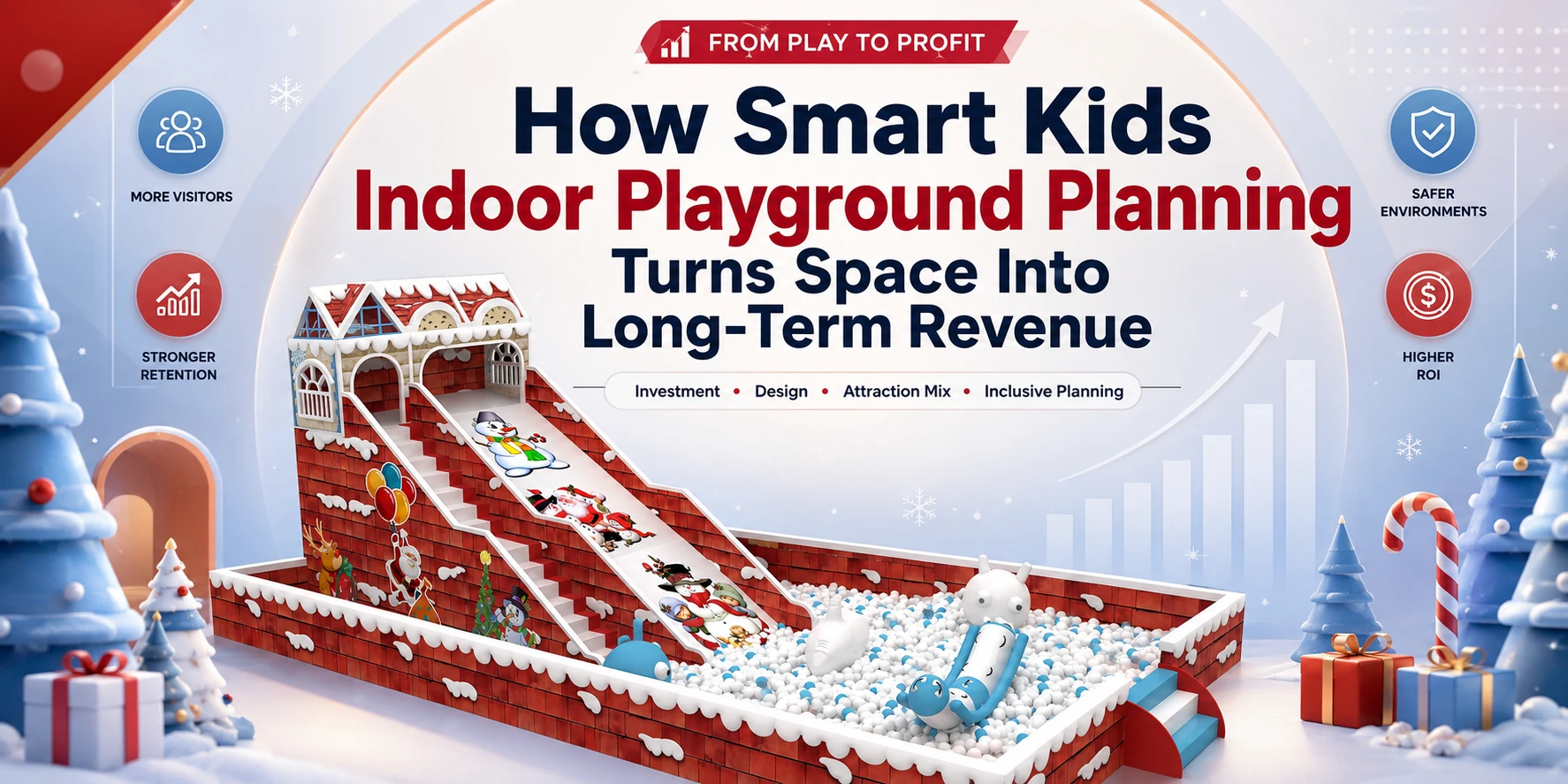
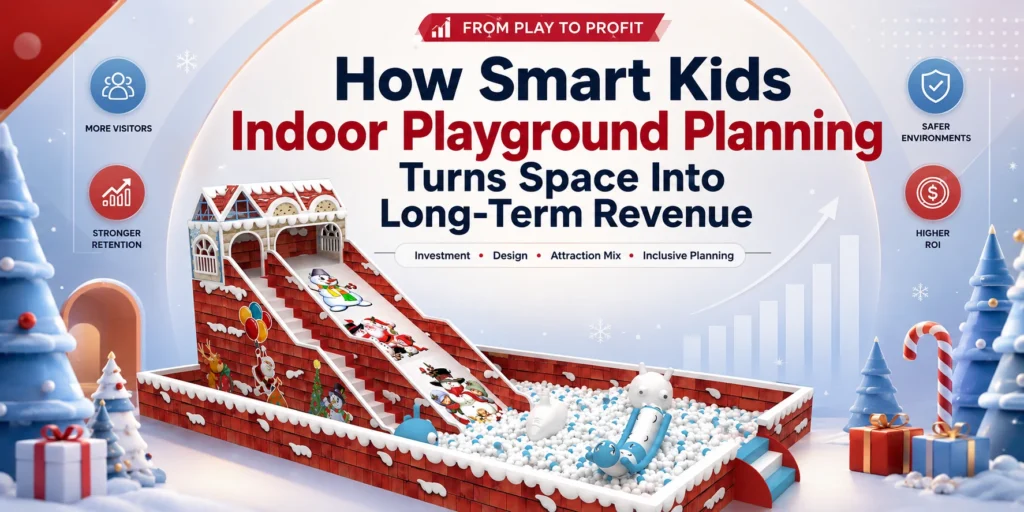
Demand for kids indoor playgrounds is rising, yet many buyers underestimate how much equipment, space, and planning a profitable venue requires. A poorly chosen mix of attractions can leave a facility underused and over budget.
A kids indoor playground is a commercial play facility designed for children under 12, typically combining multi-level play structures, soft play areas, ball pits, trampolines, and party rooms within a weather-independent indoor space.
Getting the fundamentals right from the start matters: capital investment, attraction mix, inclusive design, and daily operations all shape both visitor return rates and long-term profitability.
Market Snapshot: Who Is Investing in Kids Indoor Playgrounds
Today’s kids indoor playground market attracts four main buyer groups: real estate developers adding anchor attractions to retail schemes, family entertainment centre operators expanding their venue mix, franchisees buying into proven play concepts, and community organisations seeking accessible local facilities.
Revenue models usually combine pay-per-play entry, monthly memberships, and party packages. Birthday parties typically deliver the highest margin per square metre, so design your party rooms early.
Key market segments showing real growth:
- Premium all-inclusive family centres
- Sensory-friendly franchises with adapted hours
- Local soft-play zones for under-5s
The spread of sensory-friendly hours and non-profit inclusive centres signals demand for thoughtful design, not just standard play frames. Once you identify your segment, the next step is working out the capital required — covered in the cost breakdown below.
Indoor Playground Cost Breakdown: Equipment, Installation, and Pricing
Budget expectations vary sharply with footprint. A small kids indoor playground (1,500–3,000 sq ft) typically costs £80,000–£200,000; medium sites (3,000–8,000 sq ft) run £200,000–£500,000; large centres (8,000 sq ft or more) start around £500,000 and can exceed £1.5 million.
| Investment area | Typical share | What it covers |
| Play equipment | 40–55% | Multi-level structures, slides, ball pits, soft play |
| Installation and safety surfacing | 15–25% | Labour, foam mats, safety nets, edge protection |
| Interior fit-out | 15–25% | HVAC, lighting, flooring, theming |
| Launch and contingency | 10–15% | Party rooms, signage, project buffer |
Running costs sit outside the build budget. Staffing often consumes 25–35% of revenue, with insurance and maintenance adding another 10–15%, so model those before committing to a site. Pricing varies by square footage and equipment grade. Sourcing from best playground equipment manufacturers in China can cut equipment spend, though freight and EN 1176 certification costs partially offset that. Ask at least three reliable playground suppliers for itemised quotes showing equipment, surfacing, and installation separately. Once the budget is fixed, the attraction mix determines whether that investment pays back.
Attractions and Play Structures That Drive Repeat Visits
With the budget fixed, the attraction mix decides your payback. These categories appear most often in venue attraction lists and consistently drive usage.
- Multi-level play structures: the revenue anchor. They use vertical space, keep children exploring for hours, and extend dwell time per visit.
- Ball pits: low-cost, high-churn play that suits under-6s and creates shareable photo moments.
- Trampolines: the strongest draw for 5-12 year olds and a reliable driver of repeat visits.
- Soft play zones: safe, low-supervision areas for toddlers that reassure parents and reduce staffing strain.
- Sensory rooms: a quiet, inclusive offer that attracts families with special needs and widens your weekday audience.
- Party rooms: birthday packages are typically the highest-margin revenue stream, so size these for weekend capacity.
When shortlisting suppliers, check which attractions can be combined in one structure and how easily each zone can be extended later.
Inclusive and Sensory-Friendly Design for Commercial Play Facilities
Inclusive design is now a commercial standard. Venues such as ‘SENSORY FRIENDLY HOURS’ and the ‘Non-Profit Inclusive Family Center’ make accessibility a core differentiator. For buyers, that means checking whether suppliers can deliver equipment and layouts for children with sensory processing differences, mobility needs, or autism.
Equipment choices
Quiet zones with reduced noise and dimmable lighting give children a retreat from stimulation. Tactile panels, fibre-optic strands, and wall-mounted activity boards add low-impact engagement. Adaptive swings and floor-level soft play accommodate limited mobility. Confirm each piece meets ADA-compliant clearance and weight ratings.
Layout considerations
Place low-stimulation areas away from ball pits and trampoline zones. Curved sightlines let parents monitor children from seating without raising noise levels. Wider aisles ease wheelchair and pushchair access.
Operational practices
Sensory-friendly hours, with music off and capacity capped, attract families who avoid peak times. Staff training in de-escalation and autism awareness turns equipment into a service advantage.
When comparing supplier quotes, ask for inclusive equipment catalogues, ADA compliance documentation, and sensory-hour case studies.
Common Buyer Questions About Indoor Playground Operations
What age range should you plan for?
Most commercial venues target children aged 0-12, with separate zones for toddlers and older kids. Under-3s need lower platforms and gentler slides; ages 4-12 expect climbing challenges and speed. Local height restrictions may adjust these bands.
What capacity rules apply to party packages?
Party rooms typically hold 10-20 children per booking, with peak slots on weekends from 10:00-16:00. A practical rule of thumb is one party host per 10 children.
What supervision is required?
Staff-to-child ratios of 1:10 to 1:15 are common on the play floor, but local regulations vary widely. Parental supervision duties also differ by state or region.
What maintenance schedule is realistic?
Daily visual checks, weekly structural inspections, and annual professional audits are standard. Follow the manufacturer’s schedule for replacing mats, netting, and fasteners before they wear out.
About JQ Playground – bestplaygroundsuppliers.com
JQ Playground (Wenzhou Jiqi Amusement Equipment Co., Ltd.) is a children’s playground equipment manufacturer founded in 1993. The company provides design, customization, large-scale manufacturing, sales, installation guidance, and after-sales support for outdoor playgrounds, indoor playgrounds, soft play, water playgrounds, PE board playgrounds, kindergarten furniture, outdoor fitness equipment, pet playgrounds, and playground facilities. Approved company facts include 180+ employees, a large Wenzhou production base, 20+ production lines, 55 production machines, ISO/BSCI/EN1176/EN71/ASTM/CPC/CPSIC certification references, 100+ patents, free design support, OEM/ODM capability, trial installation before shipping, export experience, and one-year quality warranty.