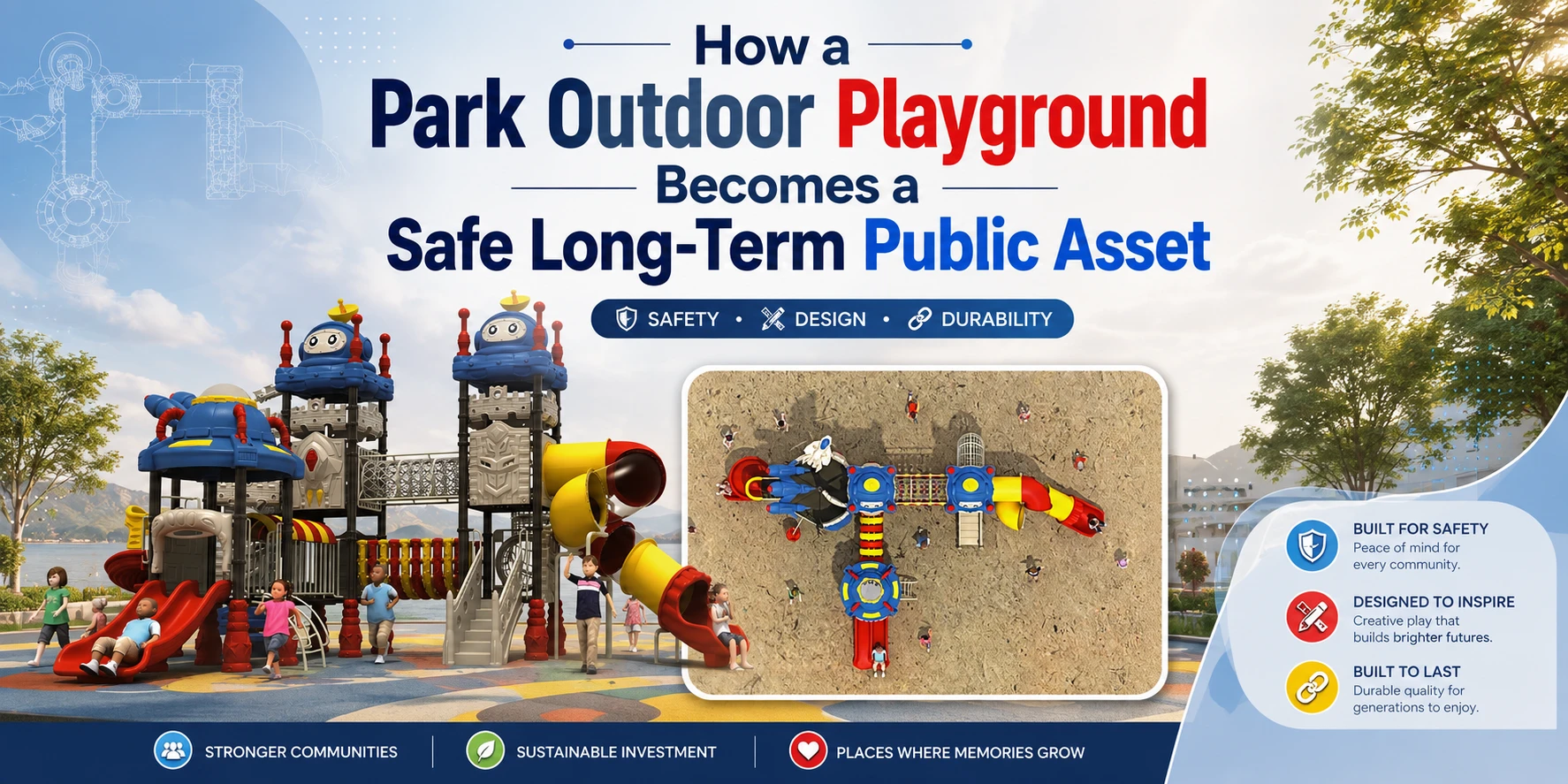
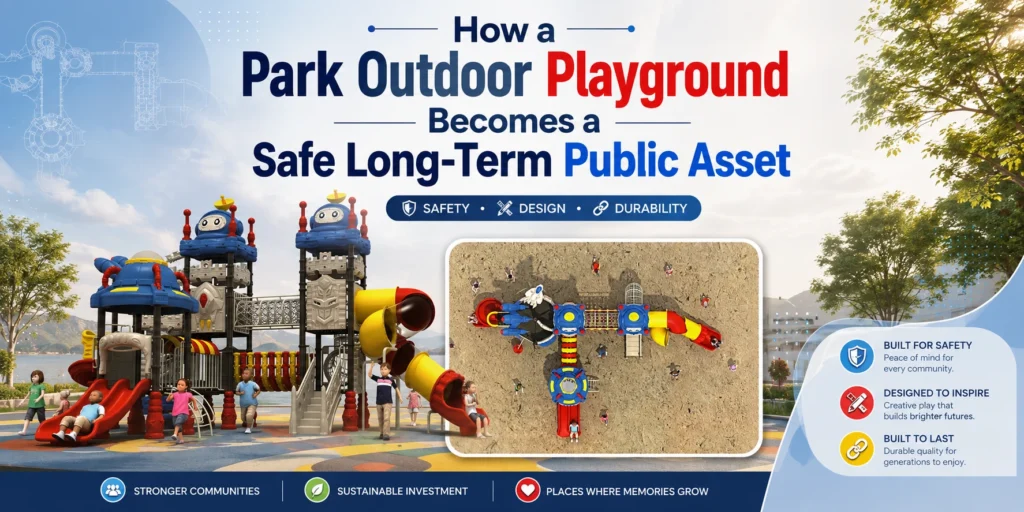
Public parks are high-traffic spaces where playground equipment must balance user experience, safety, and long-term durability. A worn surface or loose fitting quickly becomes a complaint, a repair bill, or a liability claim.
A park outdoor playground is a publicly accessible play area with commercial-grade equipment such as modular structures, swings, slides, and climbers, installed over impact-absorbing surfacing. Unlike residential sets, these installations must meet formal safety standards, withstand daily footfall and weather, and serve diverse age groups within a defined community space.
The sections below cover equipment categories, design factors, safety standards, and supplier evaluation criteria.
Park Outdoor Playground Equipment Categories and Their Commercial Value
When specifying a park outdoor playground, your equipment mix determines capacity, queue patterns, and dwell time. Each category serves a different age band and traffic role:
- Modular play structures (ages 2–12): galvanised steel posts with HDPE decks. A 50–100 m² unit holds 20–40 children and anchors the site.
- Swings (ages 2–12): steel frames, rubber or fabric seats. A two-bay set needs roughly 8 × 6 m clearance and drives queue turnover.
- Slides (ages 2–12): stainless steel or HDPE. Budget a 1.5–2 m exit zone beyond slide length.
- Climbers (ages 5–12): ropes or recycled plastic. A 3 m-high net climber needs a 5–6 m fall radius.
- Spinners (ages 2–12): compact footprints, high turnover, strong appeal for younger children.
- Balance equipment (all ages): low-height options that extend dwell time for cautious users.
- Freestanding units (ages 2–5): spring rockers and small slides fill gaps between larger zones.
Estimate capacity at one child per 2–3 m² of play area.
Design Considerations That Decide Park Playground Project Success
A park outdoor playground differs from a backyard set in one key respect: every design decision serves dozens of children at once, not two or three. Work through these six choices in order.
- Zone by age group. Separate play areas for children aged 2–5 and 5–12, with a minimum 6 m clearance between zones to stop collisions.
- Plan fall surfacing first. Poured-in-place rubber suits high-traffic routes; rubber tiles ease maintenance access; engineered wood fibre is budget-friendly but needs 300 mm depth for fall heights up to 3 m.
- Design traffic flow. Keep sightlines open from entry to exits; avoid dead-end pockets that create congestion.
- Add shade structures. Mesh or fabric canopies can cut surface temperatures on slides and decks by 15–20°C.
- Include caregiver seating. Position benches within 6 m of each play zone, with clear views.
- Meet accessibility guidelines. Provide at least one accessible route and transfer point, per ADA or your local inclusivity standard.
EN1176, ASTM F1487, and Global Safety Standards Every Buyer Should Verify
The fastest way to de-risk a park outdoor playground project is checking that each structure meets the standard for your destination market. European projects typically require EN1176. North American buyers should verify ASTM F1487 alongside CPSC guidelines. Australia and New Zealand use AS 4685; China applies GB/T 27689. These standards assess structural integrity, impact attenuation, entrapment hazards, and corrosion resistance.
Request these documents before you commit to a supplier: a third-party test report for the applicable standard, a certificate of conformity, and audit evidence covering the production run. Keep copies in your project file. Compliance proof reduces liability exposure and prevents customs or inspection delays when you build your playground supplier shortlist.
Supplier Evaluation Criteria for Park Playground Procurement
Once the safety files check out, shift your evaluation to the supplier’s operational record. A park outdoor playground typically operates 15–20 years before major refurbishment, so price alone cannot guide the decision.
- Manufacturing experience: How many public playground projects has the factory completed? Ask for the age-range split; 5–12 structures usually dominate park tenders.
- Material quality and warranties: What steel grade, HDPE thickness, and UV stabilisation do they specify? Compare warranty terms line by line.
- Custom design capability: Will they produce site-specific drawings and 3D renderings? Customisation keeps your layout and budget aligned.
- Export and logistics history: What are typical lead times, MOQs, and packaging standards? Check whether partial shipments are possible.
- Installation and after-sales support: Who supervises installation, and what is the spare-parts response time?
- Reference projects: Request three comparable park installations with contact details. Verify delivery punctuality and post-installation issues.
About JQ Playground – bestplaygroundsuppliers.com
JQ Playground (Wenzhou Jiqi Amusement Equipment Co., Ltd.) is a children’s playground equipment manufacturer founded in 1993. The company provides design, customization, large-scale manufacturing, sales, installation guidance, and after-sales support for outdoor playgrounds, indoor playgrounds, soft play, water playgrounds, PE board playgrounds, kindergarten furniture, outdoor fitness equipment, pet playgrounds, and playground facilities. Approved company facts include 180+ employees, a large Wenzhou production base, 20+ production lines, 55 production machines, ISO/BSCI/EN1176/EN71/ASTM/CPC/CPSIC certification references, 100+ patents, free design support, OEM/ODM capability, trial installation before shipping, export experience, and one-year quality warranty.