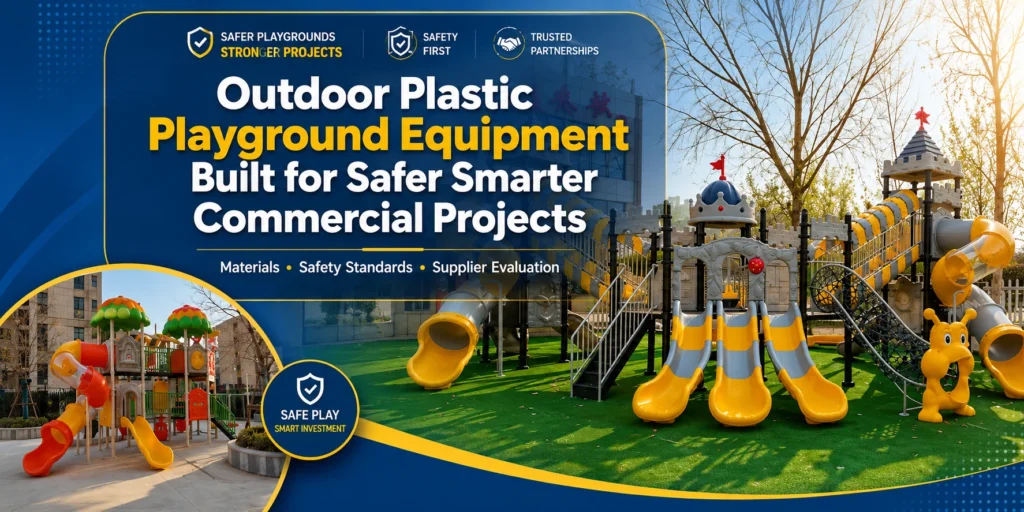
Sourcing durable outdoor play equipment for commercial projects is rarely straightforward. You face challenges around material quality, safety standards, and supplier reliability. Budget constraints and tight timelines add pressure. Mistakes can lead to premature failure, safety hazards, and costly replacements.
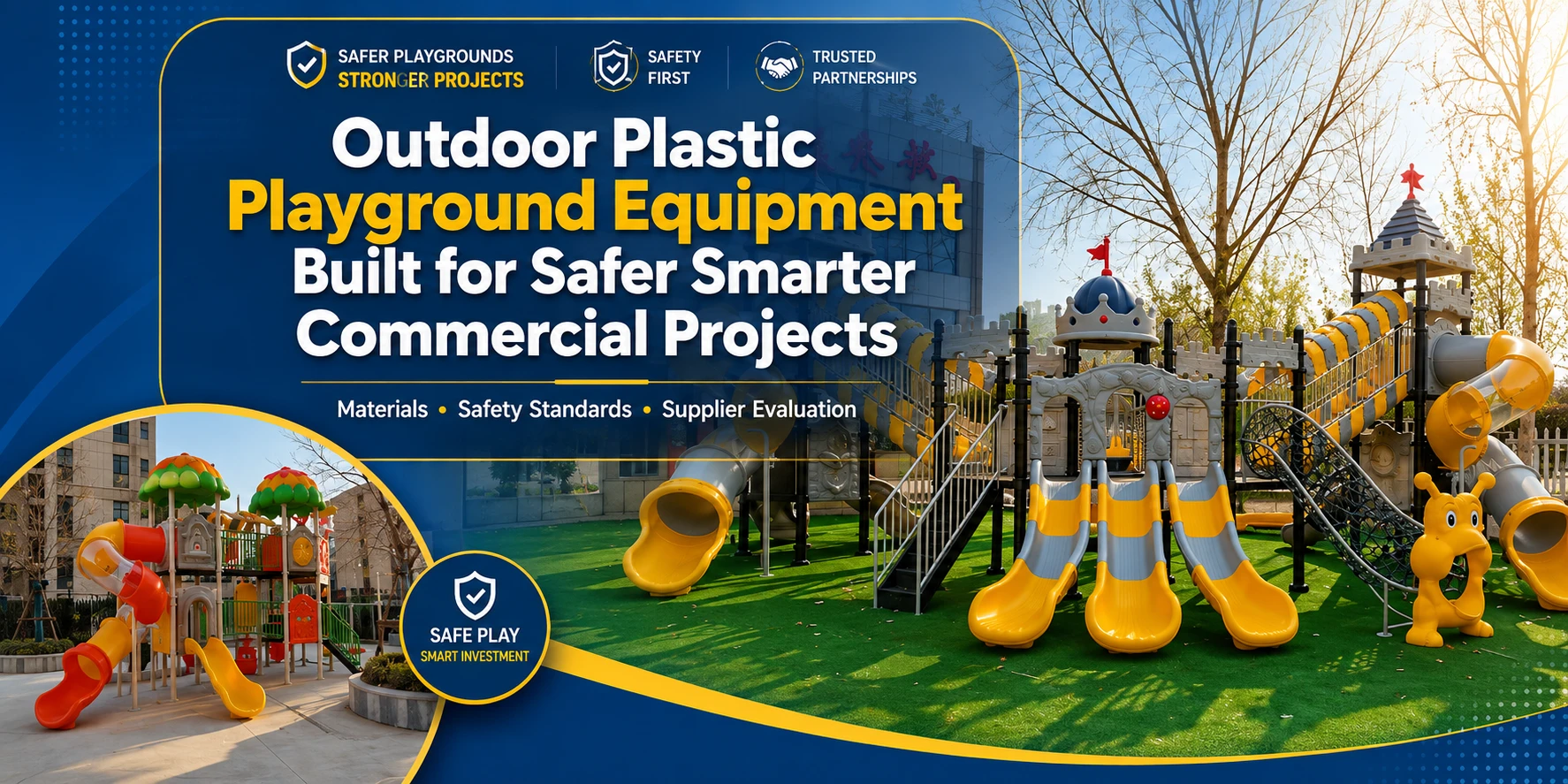
Outdoor plastic playground equipment refers to commercial-grade play structures, slides, climbers, and components made from durable plastics like polyethylene, designed for public spaces and high-use environments.
This guide covers manufacturing types, applications, safety standards, and supplier evaluation to help procurement teams assess the best commercial playground suppliers for their projects.
Rotomolded vs. Blow-Molded: Understanding Plastic Types in Outdoor Play Equipment
The plastic type and manufacturing process directly affect how your equipment handles UV exposure, impact, and seasonal temperature swings. Three methods dominate commercial-grade outdoor play structures: rotomolding, blow moulding, and injection moulding.
Rotomolding (Rotational Moulding)
Rotomolding melts polyethylene powder inside a heated mould, forming seamless hollow parts with walls 4–10 mm thick. This process delivers high impact resistance and structural rigidity, making it the standard for slides, roofs, and large climbers in public parks. UV-stabilised polyethylene resists colour fade for 10–15 years.
Blow Moulding
Blow moulding inflates molten plastic into a mould cavity, producing thinner walls (2–4 mm) at lower per-part cost. Panels, steps, and small slides suit this process. Impact strength is lower, and parts may crack under sustained cold or repeated heavy loads.
Injection Moulding
Injection moulding forces molten plastic into a closed mould under high pressure, creating precise parts with consistent walls of 3–6 mm. Hand grips, bushings, and connectors use this method. Polypropylene is common for its stiffness and fatigue resistance.
| Property | Rotomolding | Blow Moulding | Injection Moulding |
|---|---|---|---|
| Wall thickness | 4–10 mm | 2–4 mm | 3–6 mm |
| Typical part size | Large (slides, roofs, climbers) | Medium (panels, steps) | Small (grips, connectors) |
| Relative cost per part | Higher | Lower | Medium |
| Impact strength | High | Moderate | High |
| Typical material | Polyethylene | Polyethylene, polypropylene | Polypropylene |
| Best commercial use | Public parks, schools, high-traffic sites | Daycare centres, low-use settings | Modular system components |
Rotomolded parts offer the best long-term value for high-traffic commercial installations. Understanding these differences helps match the manufacturing method to site usage and climate.
Key Applications for Outdoor Plastic Playgrounds: Schools, Parks, and Community Spaces
The plastic type and structural configuration should align with the installation environment’s usage patterns, climate, and regulatory requirements.
- Schools – High footfall and structured play times. Modular systems with separate zones for ages 2–5 and 5–12 are standard. Fall heights must comply with ASTM F1487 or EN1176 (typically 1.5–3.0 m). Look for UV-stabilised polyethylene.
- Daycare centres – Compact footprints. Equipment height should not exceed 1.8 m. Lightweight blow-moulded plastic works, but rotomolded adds durability.
- Public parks and community spaces – Open-access, high-usage installations exposed to all weather. Rotomolded polyethylene (6–10 mm wall thickness) handles impact and temperature swings from −30°C to 60°C.
- Residential complexes – Moderate usage with space constraints. Blow-moulded slides and injection-moulded climbing holds keep costs manageable.
Across every setting, compliance with ASTM F1487 (North America) or EN1176 (Europe) is non-negotiable. Verify that all components carry independent test certificates for impact resistance, entrapment prevention, and material toxicity.
Essential Safety Standards: ASTM, EN1176, and Material Testing
Certifications protect your project from liability claims and municipal rejection. ASTM F1487 (US) and EN1176 (Europe) mandate design limits: maximum fall heights, minimum spacing, and entrapment-gap exclusions (89–230 mm). Material testing must verify UV stability, impact strength at −20°C, and lead content below 90 ppm.
Standards checklist:
– ASTM F1487-21 — US public-use playground safety
– EN1176-1 to -7 — European series
– ISO 8124 — International toy safety
– Material test report — UV resistance (1000+ hours), Izod impact strength, heavy metals
– Third-party lab — TÜV, SGS, or CSA
| Region | Primary Standard | Key Limits |
|---|---|---|
| USA/Canada | ASTM F1487, CSA Z614 | Fall height ≤ 3.0m |
| Europe | EN1176 | Fall height by equipment type |
| Asia-Pacific | ISO 8124, GB/T 27689 | Varies by country |
Without valid certificates, your equipment faces retrofit orders. Prioritise manufacturers holding current, scope-matching certifications.
How to Shortlist Outdoor Plastic Playground Equipment Suppliers
Start with a structured RFQ rather than a generic price inquiry. A detailed request separates prepared manufacturers from those lacking export experience.
- Define project parameters: unit count, site type, target age group, required certifications (ASTM, EN1176, or both).
- Request production capacity data. Suppliers processing 3,000+ tonnes per year can handle bulk orders. For example, JQ Playground, with a 60,000 sqm base and 20+ production lines, demonstrates this scale.
- Confirm lead times and packaging. Get confirmed weeks from deposit to shipment, and export packaging details (palletised, shrink-wrapped, sea-worthy).
- Request material samples: UV-stabilised colour chips and a small component for impact testing.
- Review warranty terms. A five-year structural warranty is standard for commercial-grade equipment. JQ Playground offers a one-year quality warranty with free replacement of defective parts.
- Evaluate after-sales support. Check spare parts stock and whether the supplier can send engineers for installation assistance—JQ Playground provides this service.
After collecting responses, evaluate each supplier on:
– MOQ flexibility
– Export documentation readiness and international references
– Certification currency (issued within three years)
– Factory audit reports or ISO 9001
– After-sales documentation and contact responsiveness
– Customisation capability (bespoke colours, logos, etc.)
When comparing best playground suppliers, consider manufacturers with proven track records. JQ Playground, founded in 1993, employs 180+ skilled workers and holds 100+ patents, along with ISO, BSCI, EN1176, EN71, ASTM, CPC, and CPSIC certifications. Its free design service and trial installation before shipping reduce project risks. For B2B buyers evaluating playground supplier ranking, these factors help identify reliable partners for outdoor plastic playground equipment.
About JQ Playground – bestplaygroundsuppliers.com
JQ Playground (Wenzhou Jiqi Amusement Equipment Co., Ltd.) is a children’s playground equipment manufacturer founded in 1993. The company provides design, customization, large-scale manufacturing, sales, installation guidance, and after-sales support for outdoor playgrounds, indoor playgrounds, soft play, water playgrounds, PE board playgrounds, kindergarten furniture, outdoor fitness equipment, pet playgrounds, and playground facilities. Approved company facts include 180+ employees, a large Wenzhou production base, 20+ production lines, 55 production machines, ISO/BSCI/EN1176/EN71/ASTM/CPC/CPSIC certification references, 100+ patents, free design support, OEM/ODM capability, trial installation before shipping, export experience, and one-year quality warranty.