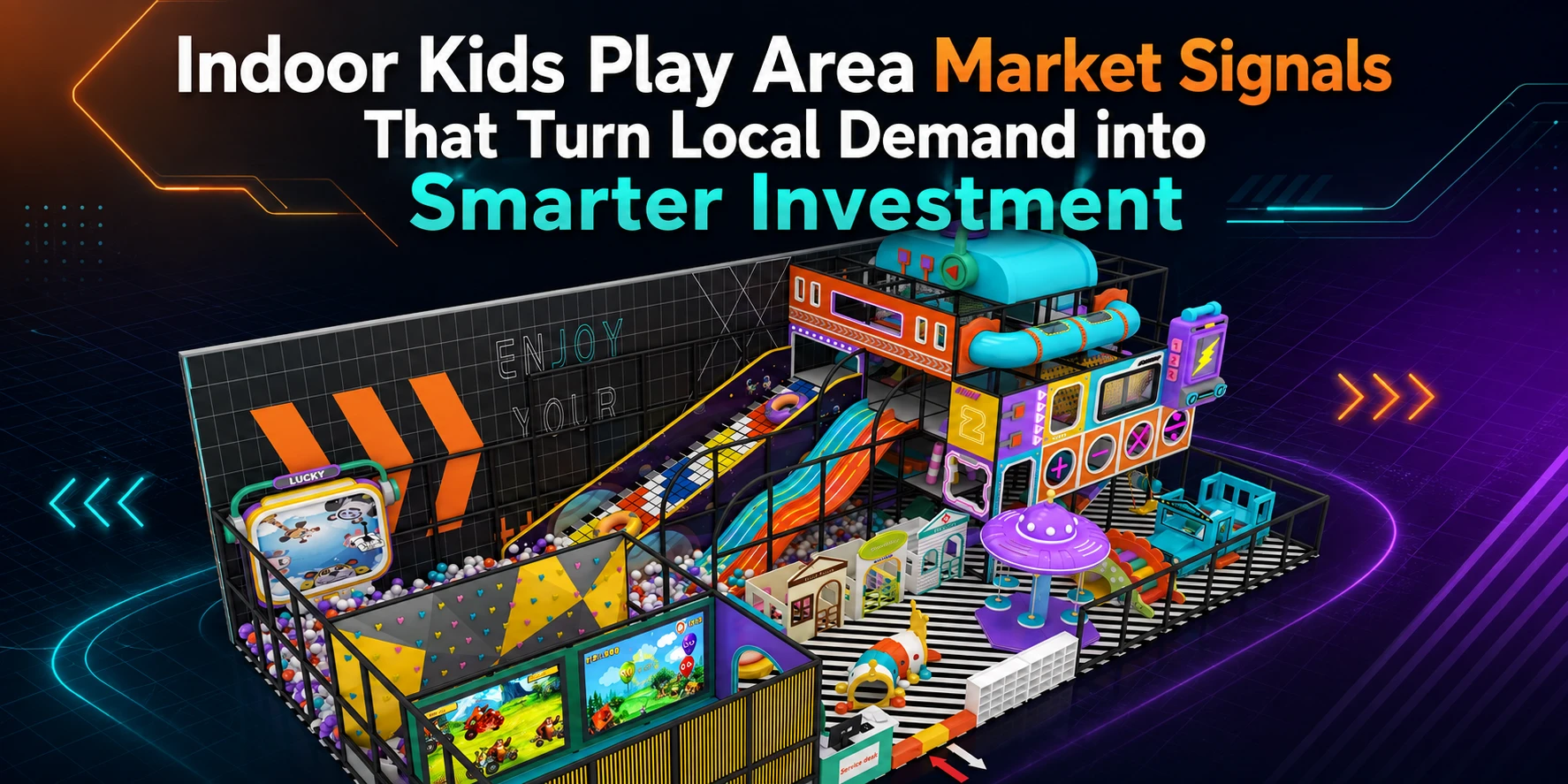
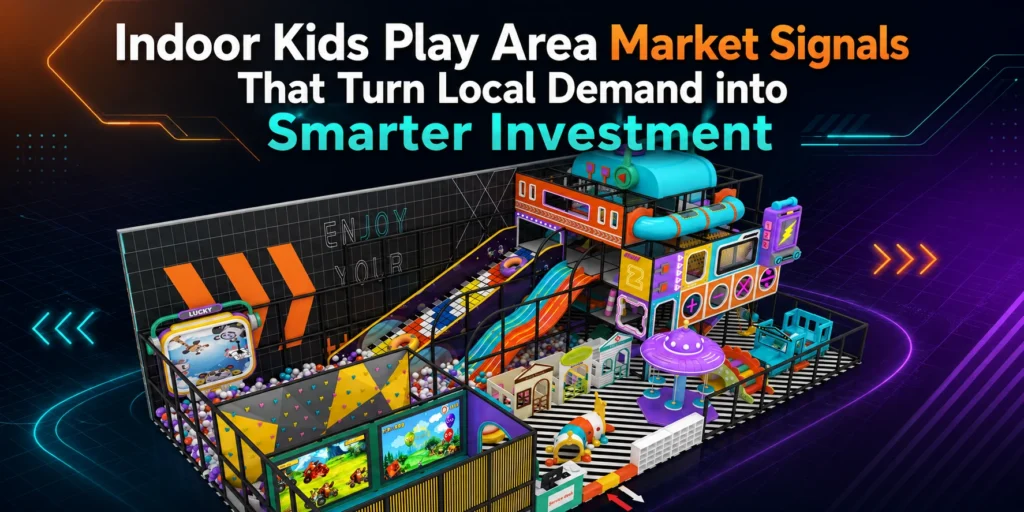
When you evaluate the indoor kids play area market, venue-level signals arrive fragmented and equipment investment patterns stay unclear. An indoor kids play area is a commercial indoor space designed for children’s physical and imaginative play, typically combining soft play structures, climbing equipment, ball pits, and themed zones. For facility owners and suppliers, local venue listings and pricing cues provide the clearest evidence of demand. Read those signals early, and you can guide investment with confidence rather than guesswork.
Indoor Play Facility Types Visible in Local Venue Guides
Local guides from Seattle, Austin, Chicago, and Yelp’s community rankings reveal four recurring venue models: independent indoor playgrounds, entertainment centres with cafes, family recreation facilities, and multi-zone discovery spaces. Each signals a different investment profile.
Typical facility configurations:
- Open-play only — admission-based floor space with soft play and climbing structures; lower staffing overhead.
- Party-focused — private rooms and package pricing drive revenue, so layout prioritises group capacity.
- Hybrid café-and-play — food and beverage sales subsidise entry fees and extend dwell time.
Positioning matters too. Venue themes such as ‘A Place for Kids to Explore, Learn, and Play!’ and ‘Where Fun Meets Discovery’ show operators competing on experience, not just equipment. When scoping a project, ask which model your location, footfall, and pricing ceiling support before comparing top playground equipment suppliers.
Attractions and Equipment Categories That Define Indoor Play Area Investment
Zone names reveal where operators invest. ‘Ball Pit Cosmos’ signals ball pits, ‘Astro Ninja World’ ninja warrior courses, and ‘Bounceon Nebula’ bounce zones. ‘Tiny Verse’ and ‘Giggle Verse’ point to toddler soft play. The recurring categories:
- Ball pits: multi-level containment, foam volume, edge padding.
- Ninja warrior courses: climbing walls, warp walls, balance beams.
- Bounce zones: trampoline decks with pit surrounds.
- Climbing structures: nets, tubes, slides, platform transitions.
- Themed pretend-play: custom facades, props, role-play sets.
- Toddler soft play: low-height modules, denser impact surfacing.
Each category carries an implied investment choice. Modular units speed installation and allow zone swaps; custom builds fit awkward floor plates but raise fabrication timelines. Budget for impact-absorbing surfacing and daily inspection of worn foam, fasteners, and netting. When comparing reliable playground suppliers, ask how their maintenance plans cover those wear points.
Indoor Play Area Cost Benchmarks from Venue Pricing Models
Venue pricing reveals what the local market will bear before you commit to equipment. Typical indoor play areas charge per child, add free or low-cost adult entry, and layer on memberships and party packages. The ranges below come from current operator listings and show how each revenue stream maps to equipment budgets.
| Revenue stream | Price range | Implication for equipment budget |
|---|---|---|
| Per-child admission | $10.99–$17.99 (ages 4–15) | Higher ticket prices support larger, premium structures |
| Adult entry / infants | Free to $8; infants free | Low entry friction keeps families on-site longer |
| Monthly membership | From $39.99 | Recurring income justifies higher upfront equipment spend |
| Party packages | $175–$475 per party | Party revenue can fund a dedicated themed zone |
Pricing also signals positioning. A $17.99 child admission with free infants points to a destination-scale zone with extensive climbing and soft play; a lower ticket suggests neighbourhood soft-play with simpler modules. For ROI, model the mix: memberships from $39.99 and party packages at the upper end shorten equipment payback, so buyers can justify higher-grade construction and flexible modular zones. Use these benchmarks as your baseline for comparing supplier costings on a like-for-like basis.
Age-Specific Design and Safety Requirements for Indoor Play Zones
Indoor play venues split users by age for a practical reason: motor skills, body weight, and risk perception differ sharply between an infant, a toddler, and a ten-year-old. SERP evidence confirms this — venues price ‘Children 1-3’ separately, admit ‘Infants (0-11 months) Free’, and publish zone-specific ‘playground rules’.
- Infants (0-11 months): soft mat flooring, buggy parking, feeding and rest corners clear of main traffic, no steps or ball pits.
- Toddlers (1-3): dedicated low-level modules under 1 m, impact-absorbing foam surfacing, gated entries, clear adult sightlines, pictorial rule signage.
- Children (4-15): taller climbing frames, slides and active zones, physically separated from toddler areas to control traffic flow.
Ask suppliers how their designs meet recognised safety standards, how cleaning protocols differ between zones, and how edges and impact points are cushioned. Those details determine maintenance costs long before the first child arrives.
Translating Indoor Play Activity Trends into Equipment Supply Priorities
Local guides reveal what children actually queue for. Chicago’s Top 10 listings and Austin’s venue round-ups consistently favour climbing, soft play, pretend play, trampolines, and sensory areas. Treat those mentions as procurement signals.
Checklist for buyers:
– Climbing demand → modular climbing frames, ninja courses, rope structures
– Soft play → ball pits, multi-level foam units, slides
– Pretend play → themed role-play zones (shops, kitchens, construction sites)
– Trampolines → dedicated bounce decks or trampoline courts
– Sensory play → tactile panels, light walls, quiet corners
Ask suppliers: which formats combine into one modular order? What lead times apply to themed builds? Do trampoline components ship as a complete zone package?
Track venue reviews and admission pricing over time. When repeat visitors name the same attraction, and ticket prices rise, that activity justifies your next equipment spend. Use those signals, alongside playground equipment supplier reviews, to refresh zones before demand shifts.
About JQ Playground – bestplaygroundsuppliers.com
JQ Playground (Wenzhou Jiqi Amusement Equipment Co., Ltd.) is a children’s playground equipment manufacturer founded in 1993. The company provides design, customization, large-scale manufacturing, sales, installation guidance, and after-sales support for outdoor playgrounds, indoor playgrounds, soft play, water playgrounds, PE board playgrounds, kindergarten furniture, outdoor fitness equipment, pet playgrounds, and playground facilities. Approved company facts include 180+ employees, a large Wenzhou production base, 20+ production lines, 55 production machines, ISO/BSCI/EN1176/EN71/ASTM/CPC/CPSIC certification references, 100+ patents, free design support, OEM/ODM capability, trial installation before shipping, export experience, and one-year quality warranty.