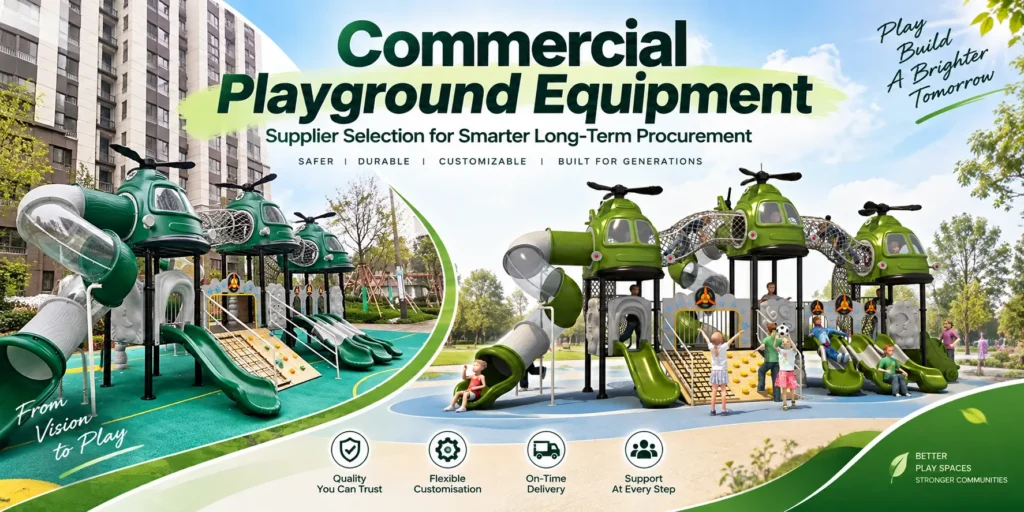
A school, park authority, or community group planning a new play area must source durable structures at scale. Orders often span several sites, age groups, and installation phases, and quotes arrive with very different cost structures. Commercial playground equipment suppliers are businesses that manufacture, distribute, or export playground systems for institutional and public use. The sections below cover how to evaluate suppliers, the main supplier types, the practical trade-offs, and a decision framework for shortlisting.
How to Evaluate Commercial Playground Equipment Suppliers
- Product range by age group: toddler, junior, and teen zones, plus inclusive pieces.
- Play style: climbing, swinging, sliding, themed, water, and shade structures.
- Application fit: parks, schools, daycares, and community sites differ in supervision and wear.
- Materials: powder-coated steel, aluminium, HDPE, moulded plastic, or timber; check wall thickness and hardware grade.
- Durability: bearings, clamps, and fasteners, plus spare parts across a 10–15 year life.
- Customisation: colour, size, theme, and modular layouts for compact footprints.
- Capacity and lead times: monthly output, workshop size, realistic delivery windows.
- Export readiness: packing, container loading, port experience, shipping documents.
- Installation support: assembly drawings, manuals, spare parts, remote or on-site help.
- RFQ responsiveness: answered specification queries, revised layouts, drawing proofs.
Matching supplier type to your project matters more than a single lowest price: distributors, manufacturers, and factory-direct exporters differ in lead time, spare-part depth, and customisation limits, so no playground supplier ranking should outweigh capability fit.
Manufacturer, Distributor, and Factory-Direct Supplier Profiles
Most shortlists of reliable playground suppliers come down to three profiles, and each solves a different problem.
- Established global manufacturers — broad catalogues covering ages 2–12, with inclusive play pieces, themed structures, and water or shade lines. Strengths: tested components and deep spare-part libraries. Limits: longer lead times, higher unit cost, and standardised modules. Best fit: multi-site rollouts needing long-term part availability.
- Regional distributors and resellers — carry stock across several brands, so local fulfilment is usually faster. Strengths: nearby delivery, installation crews, quicker site response. Limits: customisation stays close to what they hold, and pricing carries an extra margin. Best fit: smaller installations working to a tight schedule.
- Factory-direct exporters — quote straight from the production line, which opens up custom colours, logos, and non-standard configurations. Strengths: flexible tooling and competitive unit pricing at volume. Limits: you carry freight, duties, and inspection, and support runs on remote coordination. Best fit: buyers with firm specifications and freight experience.
Practical Trade-Offs When Shortlisting Commercial Playground Equipment Suppliers
Most decisions come down to speed and price against durability and control.
- Catalogue speed versus custom design. Stock modules ship sooner; bespoke themes add 4–8 weeks of design and tooling. Ask: “Which parts are stock and which are made to order?”
- Distributor support versus factory-direct cost. Local stock and site visits cost more per unit, while direct buying shifts freight, duty, and inspection to you. Ask: “Who covers damage in transit?”
- Low upfront price versus long-term durability. A cheaper bearing or deck panel can need replacing within three years. Ask: “What is the spare-part lead time, and are parts held locally?”
- Short lead time versus flexible customisation. Bulk colour and sizing changes rarely fit a six-week window.
Suppliers on a playground supplier shortlist usually price in bands — entry, mid, and project-grade. Phased purchasing then lets a school or community group buy in two or three annual stages rather than one capital outlay.
A Buyer’s Decision Framework for Choosing Commercial Playground Equipment Suppliers
Phased budgets still need one clear decision path. Work through these six steps in order.
- Define scope. Fix site size, daily user numbers, age bands (2–5, 5–12), and whether the build is a park, school, or community.
- Map categories. List swings, slides, climbing frames, inclusive pieces, shade, and surfacing, then mark which items need customising.
- Build a longlist. Pull candidates from manufacturer directories, distributor networks, and export-focused factories; aim for 8–12 names.
- Issue a structured RFQ. Request product drawings, material specifications, documentation, packaging, lead time, and sample terms.
- Compare evidence. Score capacity, project fit, spare-part supply, and risk on a weighted sheet; a custom playground supplier ranking helps only after criteria are fixed.
- Select two. Appoint a primary supplier plus a backup for phased or repeat orders.
Supplier proof, service support, and export readiness cut procurement risk before contracts are signed.
About JQ Playground – bestplaygroundsuppliers.com
JQ Playground (Wenzhou Jiqi Amusement Equipment Co., Ltd.) is a children’s playground equipment manufacturer founded in 1993. The company provides design, customization, large-scale manufacturing, sales, installation guidance, and after-sales support for outdoor playgrounds, indoor playgrounds, soft play, water playgrounds, PE board playgrounds, kindergarten furniture, outdoor fitness equipment, pet playgrounds, and playground facilities. Approved company facts include 180+ employees, a large Wenzhou production base, 20+ production lines, 55 production machines, ISO/BSCI/EN1176/EN71/ASTM/CPC/CPSIC certification references, 100+ patents, free design support, OEM/ODM capability, trial installation before shipping, export experience, and one-year quality warranty.