You are planning a play space that must survive daily public use — for a daycare’s toddler zone, a school’s gym, a church’s children’s wing, or a restaurant’s family corner. That choice affects safety records, maintenance budgets, and repeat visits.
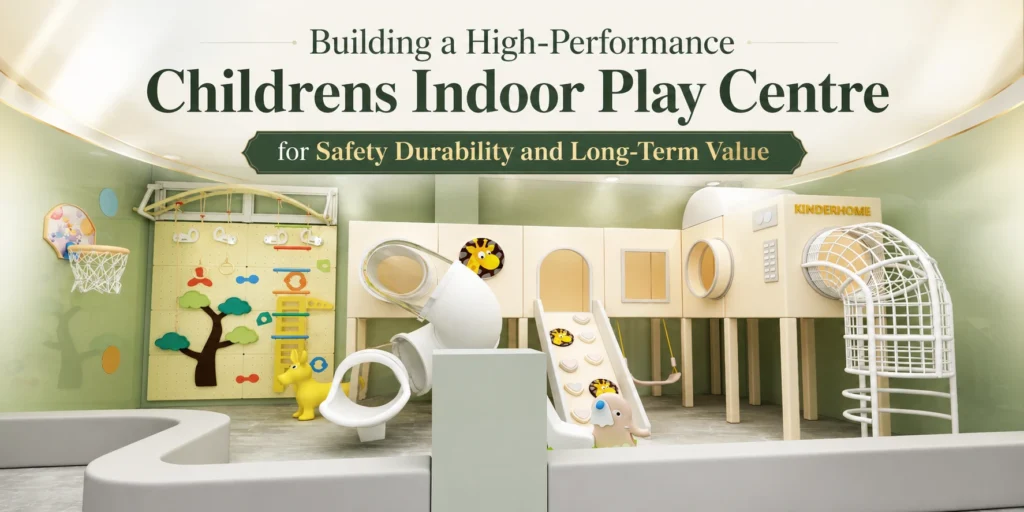
Commercial indoor playground equipment includes structural play systems, soft play components, climbing units, and indoor playsets designed for public-use facilities. These products differ from residential sets in durability, safety compliance, and installation demands.
This guide covers equipment types, safety standards, cost benchmarks, and supplier evaluation — everything you need to build a realistic shortlist and budget.
The Main Types of Commercial Indoor Playground Equipment
Modular play structures
Multi-level frames with slides, tunnels, and climbing panels dominate larger venues. They suit ages 3–12 and handle high daily traffic thanks to steel or commercial-grade plastic construction.
Soft play equipment
Sculpted foam shapes with wipe-clean vinyl covers form toddler zones. Slides, steps, and crawl tunnels suit children under 5, making them a safe fit for daycares and nurseries.
Indoor playsets
Wooden or plastic playhouses and jungle gyms fit churches, schools, and community centres. They suit ages 2–8 and work well in smaller footprints.
Climbing walls and obstacle components
Rope crossings, climbing walls, and ninja-style obstacles appeal to ages 6–14. Trampoline parks and adventure centres use them to extend dwell time.
Whichever category fits your venue, commercial-grade build and safety certification should anchor your shortlist.
Safety Standards and Materials for Commercial-Grade Indoor Playsystems
Commercial indoor playground equipment must meet far stricter requirements than residential units. For North American projects, request ASTM F1487 certification; for European buyers, EN1176 is the dominant framework. Both cover impact zones, entrapment risks, and structural integrity.
Materials matter as much as compliance. Look for hardwood frames with splinter-free surfaces, non-toxic finishes, commercial-grade plastics that resist cracking, and foam soft play components with fire-retardant properties. Every system should feature rounded edges, impact-absorbing surfaces, and clear weight limits per platform. In high-traffic indoor environments, anchoring is non-negotiable — unsecured units shift under repeated use. Custom-fit engineering also demands re-testing; bespoke dimensions cannot inherit a standard unit’s certification.
When reviewing a specification sheet, ask for test certificates, maximum load per element, anchor-point details, and replacement-part availability. Verify those before comparing prices between systems.
What Commercial Indoor Playground Equipment Really Costs
Budgeting for commercial indoor playground equipment starts with a realistic benchmark: expect roughly £75–£150 per square foot for a standard multi-level soft play or modular system, while fully customised structural installations can exceed £200 per square foot.
Off-the-shelf packages for smaller spaces, such as church nurseries or daycare rooms, may start around £5,000–£15,000 for a compact soft play set; larger modular systems typically run from £30,000 upward before installation.
Key cost drivers:
- Total square footage and ceiling height
- Soft play foam versus rigid structural components
- Custom themes, branding, or bespoke configurations
- Installation scope, design fees, and shipping distance
- Ongoing maintenance, spare parts, and safety inspections
Build these into your total budget rather than treating equipment price as the final figure.
How to Evaluate Suppliers for Commercial Indoor Playground Projects
A full-service supplier reduces project risk by owning the process from sketch to maintenance. Use this checklist to shortlist candidates:
- In-house design and 3D visualisation — Confirm they create their own layouts and renderings rather than reselling standard units.
- Custom manufacturing — Verify they can build to your floor plan, ceiling height, and specific dimensions.
- Installation services — Establish whether installation and site preparation are handled in-house or subcontracted.
- Replacement parts availability — Ask about lead times for slides, panels, and fasteners; stocked spares prevent costly downtime.
- Post-installation support — Clarify inspection schedules, maintenance guidance, and response times.
Before shortlisting, review case studies or request a virtual walkthrough of a comparable project. Seeing how a supplier manages scale, customisation, and safety compliance in practice gives you a firm basis for your indoor playground supplier comparison.
About JQ Playground – bestplaygroundsuppliers.com
JQ Playground (Wenzhou Jiqi Amusement Equipment Co., Ltd.) is a children’s playground equipment manufacturer founded in 1993. The company provides design, customization, large-scale manufacturing, sales, installation guidance, and after-sales support for outdoor playgrounds, indoor playgrounds, soft play, water playgrounds, PE board playgrounds, kindergarten furniture, outdoor fitness equipment, pet playgrounds, and playground facilities. Approved company facts include 180+ employees, a large Wenzhou production base, 20+ production lines, 55 production machines, ISO/BSCI/EN1176/EN71/ASTM/CPC/CPSIC certification references, 100+ patents, free design support, OEM/ODM capability, trial installation before shipping, export experience, and one-year quality warranty.