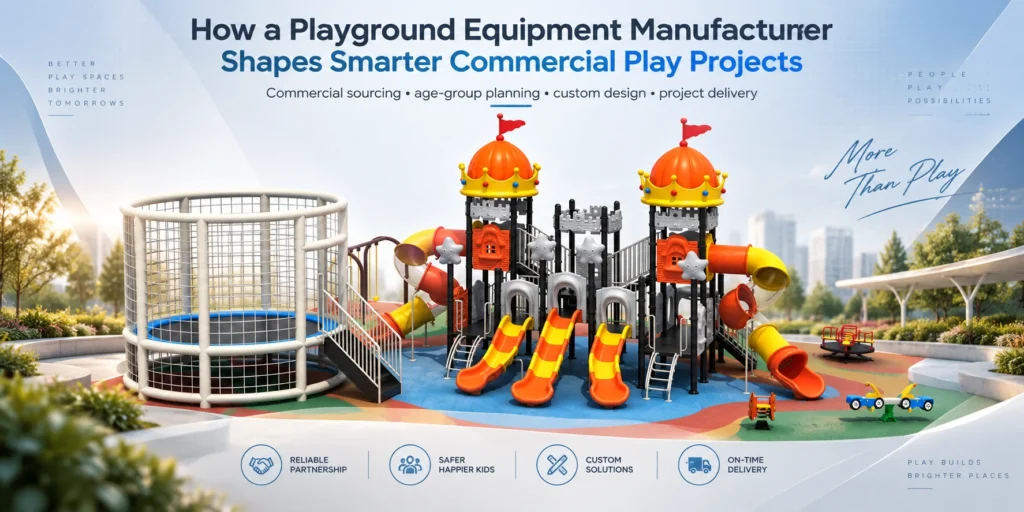
You have a capital budget approved for three play areas and a committee expecting a shortlist by month end. Two structures on your largest site are past their service life, one site is a new build with a 60 m² footprint, and your insurer wants documented inspection records. Suddenly the question is not which slide looks best. It is which playground equipment manufacturer can cover the right age bands, hold spare parts for a decade, and still answer a technical query in week six. Procurement teams usually begin by comparing breadth, not price.
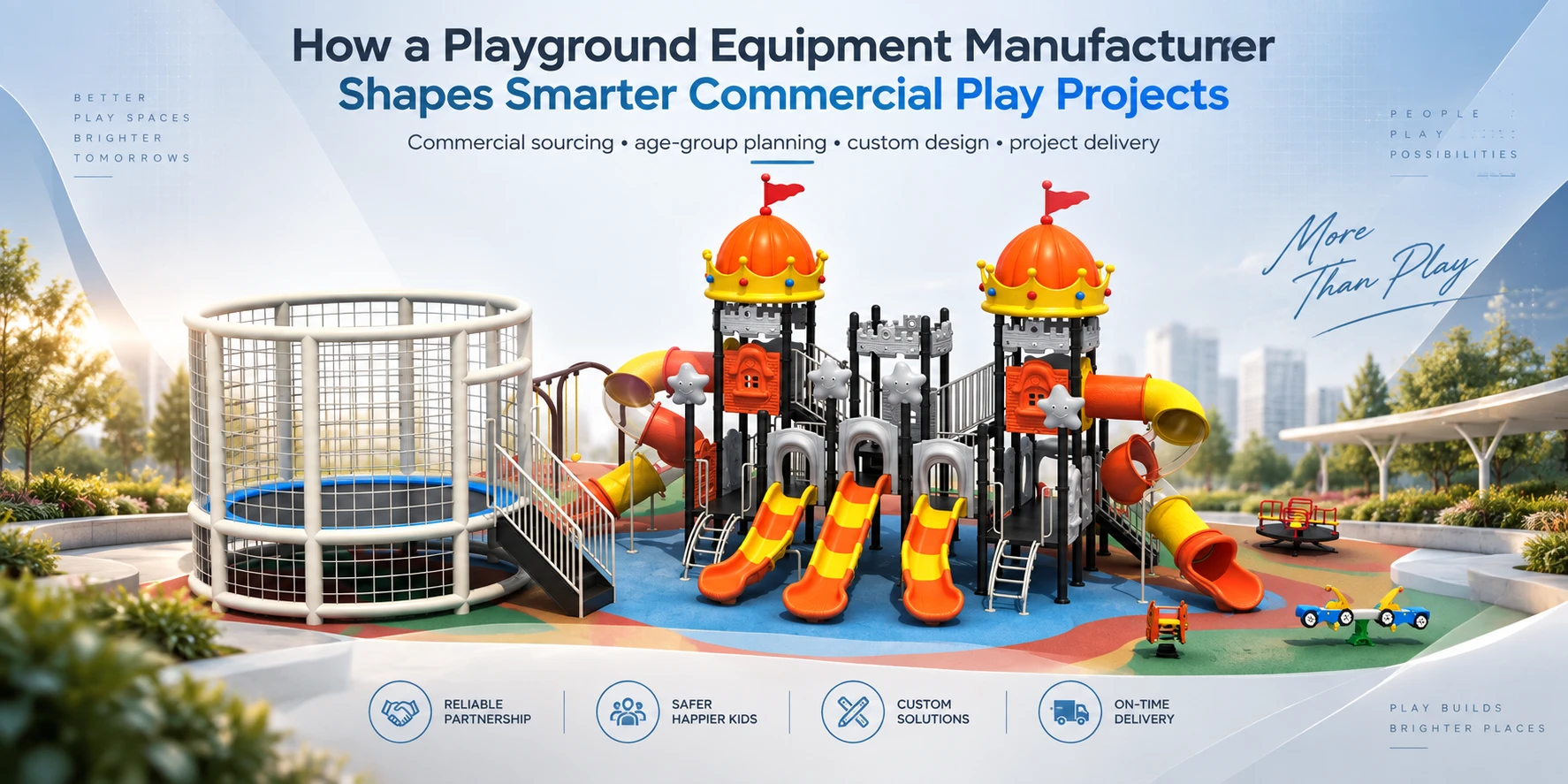
A playground equipment manufacturer designs, fabricates, and supplies play structures and components for commercial settings. The role typically spans age-banded ranges (commonly 2–5 and 5–12 years), freestanding items, play structure components, inclusive and water play, and custom configurations. Manufacturers may also coordinate delivery, installation, and replacement parts. They differ from distributors and installers, who resell or assemble rather than produce.
The sections below set out the criteria buyers apply, how equipment categories map to age and site size, the markets served, how to compare sourcing routes, and build-versus-buy delivery models. Together they show what separates the best commercial playground suppliers from resellers.
Shortlisting Criteria for Commercial Playground Equipment Manufacturers
Judge the catalogue before the unit. A manufacturer running its own production can confirm a 5–12 year age band, a specific post configuration or a bespoke layout, while a reseller usually quotes only what a factory already builds.
Work through six checks on every shortlist:
- Range breadth: structures, freestanding items, inclusive pieces, water play and shade in one catalogue.
- Category coverage: toddler, 5–12 and teen age bands plus several play styles, not one range.
- Custom design: site-specific layouts, colour and theme changes, surfacing coordination.
- Installation and project support: design drawings, site surveys, delivery scheduling.
- Replacement parts: stocked components and lead times years after handover.
- Completed commercial projects: comparable site sizes and user groups.
Buyers shortlisting the top playground equipment suppliers ask the same six questions, then compare written answers before judging how each catalogue covers specific age bands and play styles.
Playground Equipment Categories and Age-Group Fit
Category navigation on a playground equipment manufacturer site usually runs along two axes at once: age band and play style. Buyers apply both filters before checking site size, because a catalogue entry can be right for the users and wrong for the plot.
- Commercial playgrounds by age group — 6–23 months, 2–5 years, and 5–12 years. Deck heights, guardrail requirements and use zones shift with each band, so a 5–12 composite needs noticeably more clear space than a toddler unit.
- Play styles — climbing, sliding, sensory, role-play and challenge courses. Style decides how many children occupy a structure at one time.
- Components and freestanding items — decks, posts, slides, swings, spring riders and spinners, specified separately when a project is installed in phases.
- Custom and inclusive play — ramps, transfer stations and ground-level activities, often used where plots are irregular or access is restricted.
- Water play and shade structures — purchased alongside the main play area rather than replacing it.
Then match category to capacity: 200 m² rarely fits a 5–12 composite plus swings, while a 300-pupil school needs throughput over novelty.
Markets Served by Playground Equipment Manufacturers
Design intent shifts with the buyer type. Use this list to frame an outdoor playground supplier comparison before you build a playground supplier shortlist.
- Public parks: mixed ages and high daily throughput. Check age zoning (2–5 and 5–12), surfacing depth, and step-free routes between play zones.
- Schools: reception to Year 6. Confirm capacity for one or two classes at once, sightlines for supervision, and curriculum-linked climbers.
- Daycare centres: under-fives with closer supervision. Prioritise low deck heights, rounded edges, and compact footprints under 100 m².
- Churches and community spaces: volunteer-led upkeep and shared calendars. Look for modular kits with parts one person can inspect weekly.
- Neighbourhoods: small infill plots, often 50–150 m². Weigh freestanding items against composite structures on tight ground.
- Outdoor fitness areas: teen and adult users. Match spacing to circuit flow and confirm impact surfacing suits heavier loading.
Fit factors vary by market. The next question is who builds the hardware and how sources differ.
Who Manufactures Playground Equipment and How Buyers Compare Sources
A playground equipment manufacturer sits at one of four points in the supply chain. Original equipment manufacturers (OEMs) cut, weld, powder-coat and assemble in their own plants, so they control tolerances and custom tooling. Licensed suppliers build to a third party’s design. Distributors resell without fabrication capacity. Installation partners handle groundwork, surfacing and site checks.
Compare sources on:
- Factory capability — in-house metal fabrication, coating and timber treatment
- Catalogue depth — how many age, style and inclusive categories are covered
- Customisation — modular edits versus fully bespoke fabrication
- Export experience — documentation and packaging for your region
- Project references — comparable site sizes and user age groups
Buyers often assemble a shortlist from custom playground supplier ranking pages, trade directories and peer projects before requesting quotes. The delivery model you choose then shapes what you ask each source to price.
Build, Buy, Funding, and Full-Service Delivery Models for Playground Projects
Buying prefabricated equipment is usually cheaper per unit than commissioning a bespoke build, because you pay for a proven design rather than drawings, tooling and one-off fabrication. Custom work costs more, but it handles awkward sites, themed play and mixed age groups. Hybrid delivery sits between the two: catalogue modules combined with custom elements. Playground equipment supplier reviews often compare unit prices without stating which route was quoted.
| Delivery route | Lead time | Cost pattern | Design control | Fits best |
|---|---|---|---|---|
| Prefabricated purchase | Weeks, from catalogue stock | Lowest per unit | Standard options only | Flat sites, fixed layouts, capped budgets |
| Custom build | Months, design plus fabrication | Highest per unit | Full, including layout and theming | Irregular ground, signature or inclusive schemes |
| Hybrid | Between the two | Mid-range | Partial | Phased projects and staged budgets |
Funding shapes procurement. Grant-funded schemes generally need itemised costs by phase, proof the design meets accessibility standards, and quotes that separate equipment from groundwork. Suppliers advertising funding guidance typically provide budget frameworks, phased purchase schedules and documentation packs for applications.
Full-service delivery bundles site survey, design planning, custom fabrication and installation coordination into one scope. It costs more upfront than supply-only but removes gaps between installers and equipment. Where your contractor is already on site, splitting supply from installation usually cuts cost.
About JQ Playground – bestplaygroundsuppliers.com
JQ Playground (Wenzhou Jiqi Amusement Equipment Co., Ltd.) is a children’s playground equipment manufacturer founded in 1993. The company provides design, customization, large-scale manufacturing, sales, installation guidance, and after-sales support for outdoor playgrounds, indoor playgrounds, soft play, water playgrounds, PE board playgrounds, kindergarten furniture, outdoor fitness equipment, pet playgrounds, and playground facilities. Approved company facts include 180+ employees, a large Wenzhou production base, 20+ production lines, 55 production machines, ISO/BSCI/EN1176/EN71/ASTM/CPC/CPSIC certification references, 100+ patents, free design support, OEM/ODM capability, trial installation before shipping, export experience, and one-year quality warranty.