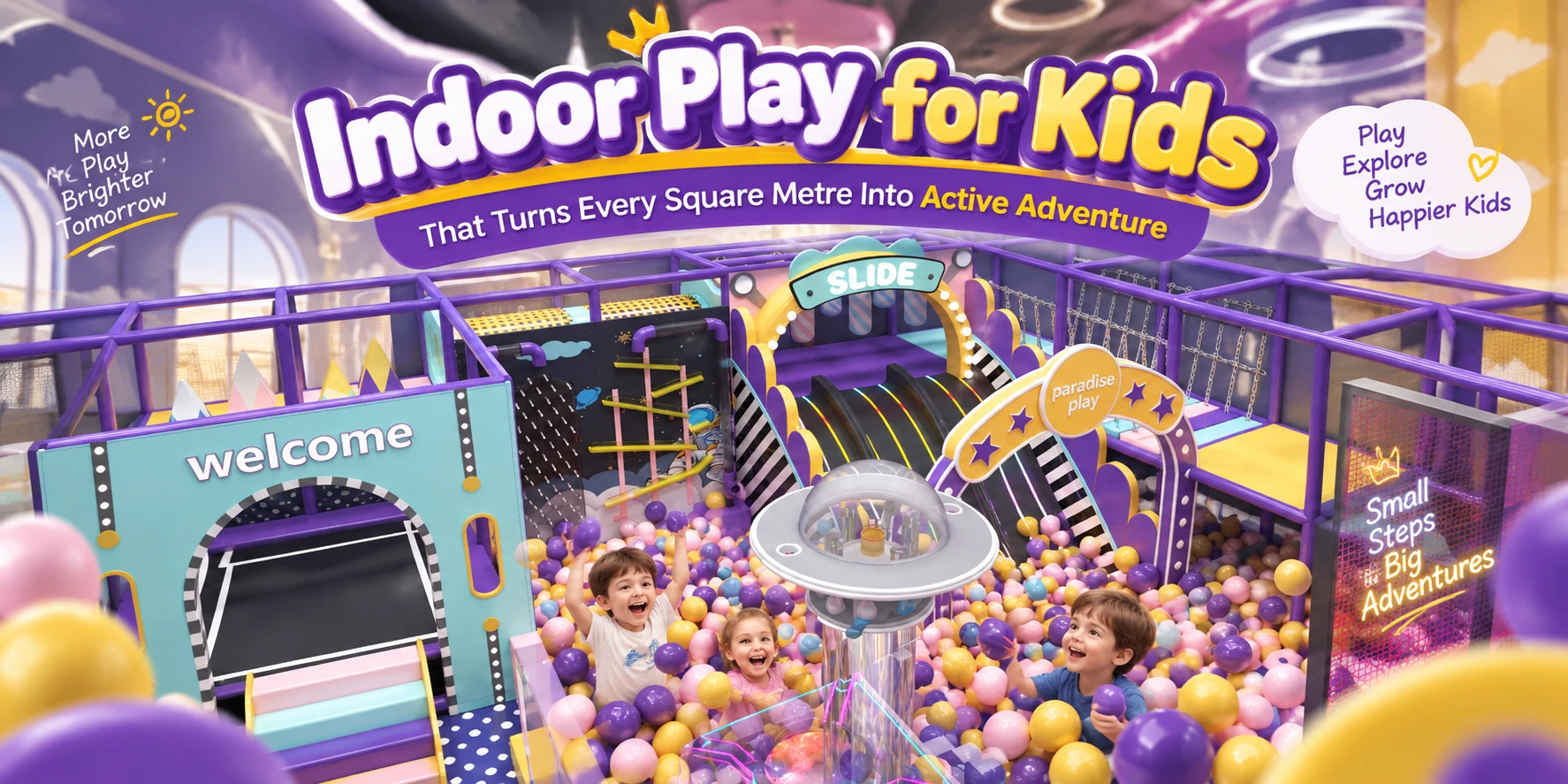
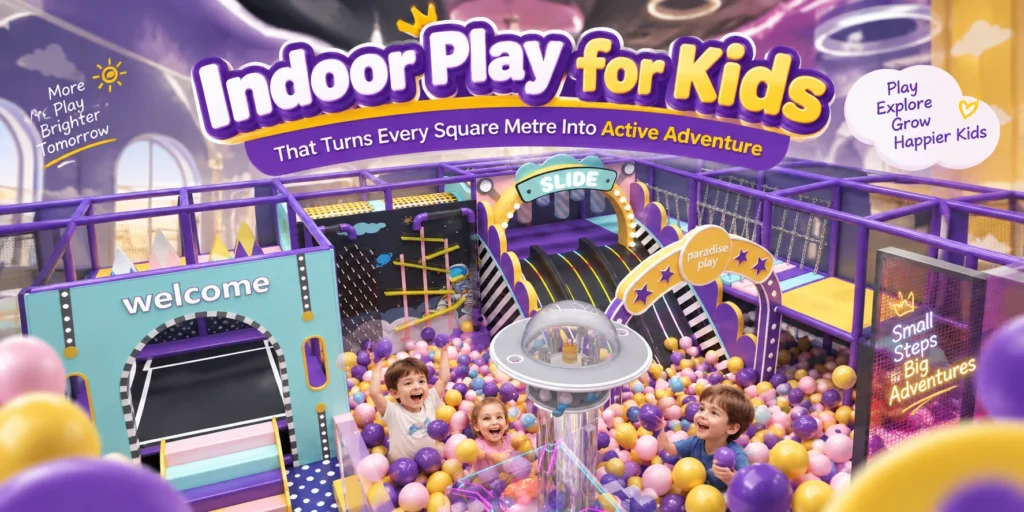
When rain, heat, or limited outdoor space stalls playtime, energy has nowhere to go. Children grow restless, screens fill the gap, and venues without an indoor option lose those visits. Indoor play for kids solves this with a safe, supervised space for climbing, sliding, and socialising in any weather.
Indoor play for kids is supervised physical and social activity inside an enclosed building, using soft-play frames, slides, ball pits, climbing zones, and obstacle courses to build motor skills, coordination, and confidence when outdoor play is impossible.
Operators comparing best playground suppliers need to know how these spaces work.
How Indoor Play For Kids Work
Indoor play for kids works on a simple exchange: physical effort in, developmental benefit out.
- Entry and safety screening – staff check height, socks, and any access restrictions.
- Zoned play – children self-select between soft play, climbing frames, slides, or ball pits.
- Supervision loop – sightlines and padding let staff observe without crowding the space.
- Exit and sanitisation – high-touch surfaces are cleaned between sessions to keep repeat visits safe.
Component Roles
Each zone has a specific function: foam structures absorb impact, netting contains active climbers, and ball-pit balls provide sensory resistance. Buyers should check that each component matches the age range and footprint intended.
Sourcing warning: confirm the supplier’s load-test documentation before purchase—not all soft-play foam holds up under daily commercial use.
This operating model sets the base for choosing equipment. Next, compare how component types change cost, layout, and safety requirements.
Indoor Play For Kids Components and Product Types
Indoor play equipment falls into four main product families, each with distinct components, safety demands, and budget drivers. A short comparison table helps you shortlist before requesting quotes.
| Product type | Core components | Buyer’s key check |
|---|---|---|
| Soft play modules | Foam shapes, PVC leather covers, base mats | Foam density and cover seam strength |
| Climbing frames | Steel or timber posts, platforms, ropes, nets | Fall height versus safety floor depth |
| Ball pits | Shell panels, netting, foam balls | Ball volume and non-toxic ball grade |
| Slides and tube runs | HDPE mouldings, tube sections, exit chutes | Slide height, angle, and anchor fixings |
Before you finalise an RFQ:
- Confirm age bands and load ratings—they dictate component thickness and fixings.
- Specify flame-retardant foam, non-toxic paints, and anti-bacterial finishes.
- Request spare-part lists for covers, balls, springs, and fasteners to plan long-term maintenance.
With the product family set, the floor plan and age mix will narrow the final option quickly.
Typical Applications for Indoor Play For Kids
Where the play area sits determines what you need to buy, so work backwards from the setting before shortlisting suppliers.
- Day nurseries and pre-schools — low-height platforms, padded ball pits, and soft shapes suit 30–80 m² rooms. Ask for small-parts test records and a daily inspection checklist that comes with the structure.
- Family entertainment centres (FECs) — multi-level towers and slides carry high turnover. Specify replaceable panels and spare connection points; then demand pre-shipment batch sampling before the full container is released.
- Restaurants and cafés — compact, fire-retardant modules with wipe-clean surfaces are the norm. Request evidence of at least 500 site installations to judge durability.
- Schools and community halls — modular layouts with wheelchair-friendly entry points. Confirm the supplier publishes per-bay quantities so you can stage delivery around term breaks.
Once the application is fixed, the next decision is whether a standard catalogue unit fits the floor plan or your project needs a fully custom build.
Custom Indoor Play For Kids Manufacturing and OEM Cooperation
When a catalogue layout cannot fit your floor plan, custom indoor play for kids equipment follows a defined path. Send drawings, reference photos, or an existing sample to begin the quote. Each stage below clarifies your input and the manufacturer’s output.
| Stage | Your input | Manufacturer output |
|---|---|---|
| Quote | Floor plan, drawings, target quantity | Feasibility check and itemised quote |
| Sample | Approval of materials and colours | Sample build or layout confirmation |
| Production | Batch size, logo, packaging marks | Inspection records per batch |
| Shipment | Delivery address and schedule | Packed items with packing list |
Inspection Before Dispatch
Ask for three checks at minimum: frame stability, fastener torque, and edge or surface smoothness. Request batch photos and a pre-shipment report before containers leave.
Top 10 Indoor Play For Kids Manufacturers and Supplier Fit
Once pre-shipment checks pass, the real test is supplier fit. No single factory suits every project, so shortlist by your buying pattern: one-off soft-play rooms, multi-site fit-outs, or repeat container orders.
| Supplier type | Pros | Cons | Best fit |
|---|---|---|---|
| Full-range Chinese playground factories | Deep vertical integration; strong pricing on large orders; custom OEM work | Minimums can be high; lead times stretch in peak season | Volume buyers screening via “best playground factory China” criteria |
| Specialist indoor soft-play builders | Superior foam, netting and safety-surface expertise; faster design iterations | Narrower product range; premium pricing | Centres prioritising safety compliance over cost |
| Domestic trading/export agencies | English-language coordination; consolidated multi-vendor shipments | Added margin; less direct quality control | First-time importers needing hand-holding |
| Local installer/regional reseller | On-site warranty response; simpler logistics and compliance paperwork | Highest unit cost; limited customisation | Single-site operators with tight schedules |
Score each candidate on: sample lead time, crimping-style RFQ detail, inspection transparency, packaging standards, and penalty-free rework terms. Weight those by your project stage, not by brochure size.
A supplier that accelerates samples but resists batch inspection reports is a sourcing risk, not a sourcing advantage.
About JQ Playground – bestplaygroundsuppliers.com
JQ Playground (Wenzhou Jiqi Amusement Equipment Co., Ltd.) is a children’s playground equipment manufacturer founded in 1993. The company provides design, customization, large-scale manufacturing, sales, installation guidance, and after-sales support for outdoor playgrounds, indoor playgrounds, soft play, water playgrounds, PE board playgrounds, kindergarten furniture, outdoor fitness equipment, pet playgrounds, and playground facilities. Approved company facts include 180+ employees, a large Wenzhou production base, 20+ production lines, 55 production machines, ISO/BSCI/EN1176/EN71/ASTM/CPC/CPSIC certification references, 100+ patents, free design support, OEM/ODM capability, trial installation before shipping, export experience, and one-year quality warranty.