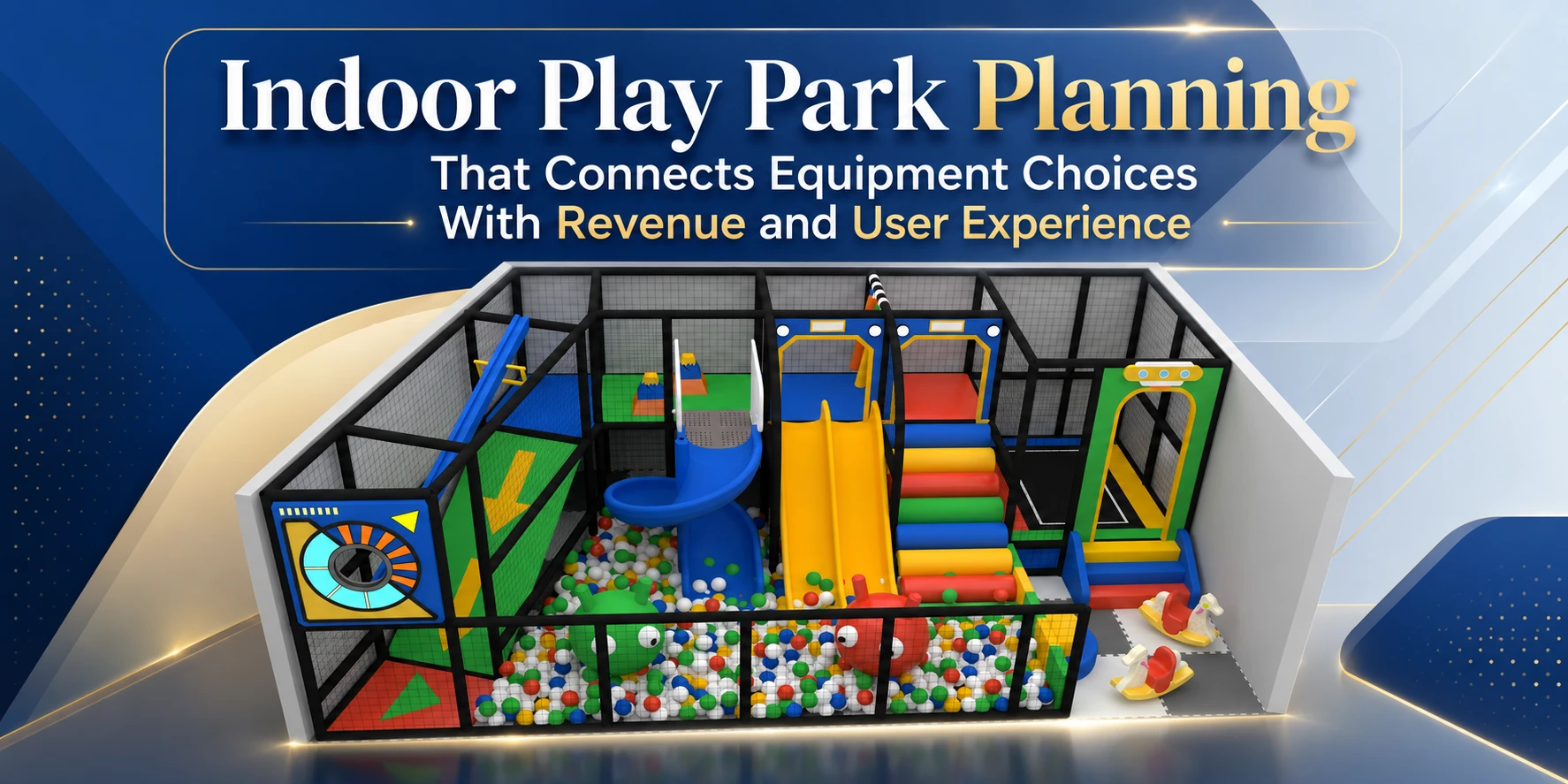
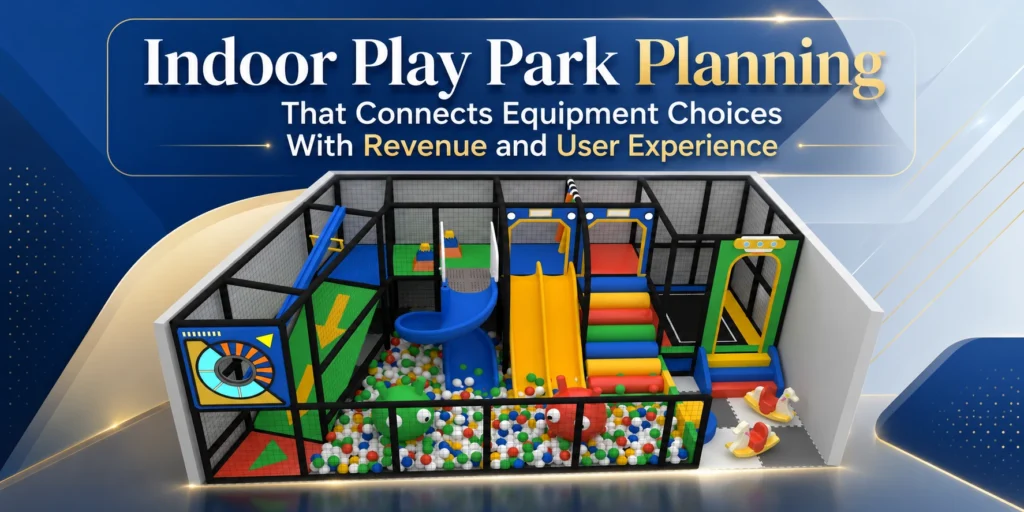
Global B2B buyers need to benchmark proven indoor play park concepts and operating models before sourcing commercial equipment. An indoor play park is a climate-controlled commercial facility designed for children’s unstructured play, typically featuring soft play structures, climbing equipment, party rooms, and areas for open play, commonly monetised through admissions, memberships, and parties. This outline analyses live operator pages to identify the equipment and design patterns that drive procurement decisions.
Open Play, Party Packages, and Event Spaces: What an Indoor Play Park Is Built Around
Operator pages define the indoor play park as a three-stream business. Flying Apple publishes ‘Open Play’, ‘PLAY. PARTY. CELEBRATE.’, and ‘PLAY. PARTY. EVENTS.’ as separate headings; Complete Playground runs a ‘Reserve Your Party’ section. Together they confirm the revenue zones: open sessions, birthday packages, and private event hire.
The spatial layout follows these streams:
– Open play: a clear span for soft play, slides, and climbing frames, with a check-in counter and queueing area.
– Party rooms: partitioned spaces with party tables and seating, placed near the main floor for supervision.
– Event space: flexible hire for school groups or corporate bookings, using movable furniture.
Translate each zone into a procurement category: climbing frames and slides for open play, party tables for the rooms, and queueing barriers for the entrance. That service-to-equipment mapping is the first step when you evaluate top playground equipment suppliers.
Admission Price Benchmarks and Party Package Rates from Live Operator Pages
Live operator pages publish admission and party rates that serve as market evidence for your revenue model. One standard party plan is listed at $575, signal-ling what families will pay for a room, attendant, and play time. The Kids Town publishes ‘Admission prices’ and open play rates, so you can benchmark entry fees against party income before you commit to a supplier.
Typical published ranges:
– Open play: $8-$15 per child
– Party packages: $250-$575
– Memberships: monthly or annual passes
These tiers shape procurement decisions. Party-heavy venues need tables and flooring that tolerate repeated cleaning and heavy use; admission-led venues require durable soft play that handles constant rotation. Capacity planning follows pricing structure — memberships demand more open-floor density, while party packages demand partitioned rooms and storage. For B2B buyers, these benchmarks build a credible business case: they tie equipment cost to per-hour revenue and expected payback, which makes the case for commercial-grade rather than domestic-grade purchases.
Segmented Play Areas for Different Ages and Sensory-Friendly Needs
Those same live pages show how an indoor play park floor plan divides by age and need. Complete Playground advertises ‘SENSORY FRIENDLY HOURS’ for ‘neurotypical and neurodivergent children of all ages’, while other operators segment from babies (8 months to 3 years) through ages 1-10 and run ‘all ages’ sessions.
- Toddler zone — soft play blocks, low platforms, and crawl tunnels, protected by thick mats and low barriers.
- School-age zone — taller climbing frames, slides, and interactive panels rated for heavier, faster use.
- Sensory-friendly space — quieter lighting, soft surfaces, and muted colours, with adjustable features like dimmable lights.
For procurement, these zones dictate mat density, barrier height, and structural load ratings. Specify adjustable components at RFQ stage so one layout serves multiple age bands and reduces retrofit costs.
How Venue Demand Translates into Commercial Equipment Orders
Yelp listings and listicles of New York indoor playgrounds are demand evidence, not just directories. Dense clusters of venues show that families already pay for admissions, memberships, and parties. Manufacturer ‘Top 10’ articles add a second signal: which product categories suppliers expect to sell next.
Follow a four-step process:
- Identify high-demand neighbourhoods from listing density and review counts.
- Analyse operator service menus for recurring offers such as open play, parties, or sensory hours.
- Translate those services into an equipment shortlist aligned to your floor plan.
- Send RFQs to suppliers with specific space dimensions and age zone requirements.
The equipment mix follows the business model. A party-centric operator needs party tables, queueing zones, and wide open play areas for group bookings. A sensory-friendly venue needs quieter corners, lower lighting, and soft, segmented structures. Local listings provide the market justification for commercial-grade specifications — and a stronger basis for an indoor playground supplier comparison.
About JQ Playground – bestplaygroundsuppliers.com
JQ Playground (Wenzhou Jiqi Amusement Equipment Co., Ltd.) is a children’s playground equipment manufacturer founded in 1993. The company provides design, customization, large-scale manufacturing, sales, installation guidance, and after-sales support for outdoor playgrounds, indoor playgrounds, soft play, water playgrounds, PE board playgrounds, kindergarten furniture, outdoor fitness equipment, pet playgrounds, and playground facilities. Approved company facts include 180+ employees, a large Wenzhou production base, 20+ production lines, 55 production machines, ISO/BSCI/EN1176/EN71/ASTM/CPC/CPSIC certification references, 100+ patents, free design support, OEM/ODM capability, trial installation before shipping, export experience, and one-year quality warranty.