Choosing an outdoor playground for toddlers in a commercial setting is deceptively difficult. Standard equipment for older children creates fall and entrapment hazards, while cheap kiddie sets fail safety audits and deteriorate within a season. Buyers need age-appropriate design, compliance proof, and budget realism — but rarely have playground engineering expertise in-house.
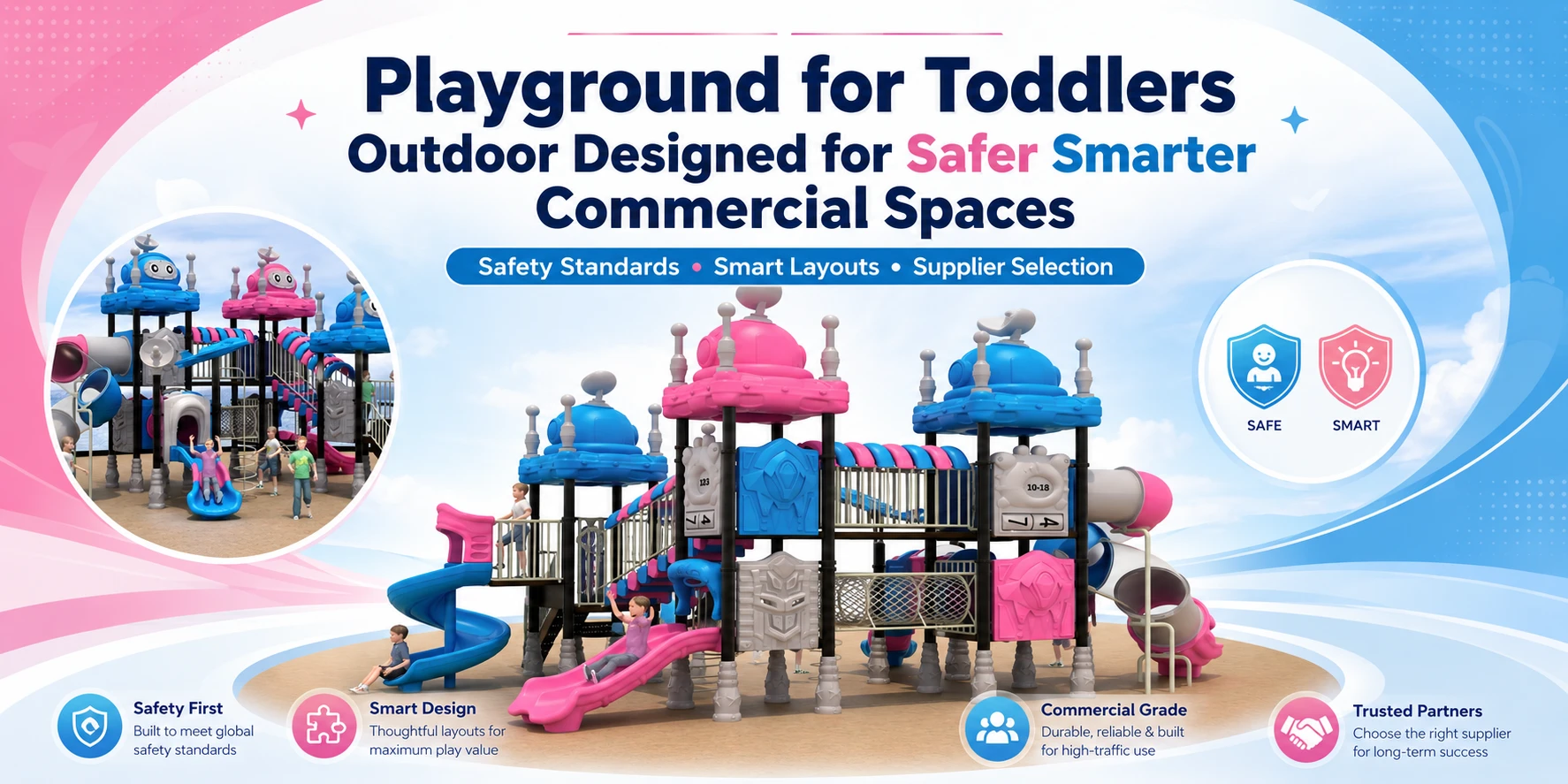
A toddler outdoor playground serves children aged 1-3 years: low-height structures with ramps, mini slides under 1.2 m fall height, bucket swings, crawl tunnels, sensory panels, and soft surfacing such as poured rubber or engineered wood fibre.
This guide covers equipment essentials, safety standards, installation settings, and supplier selection — so you can shortlist the best playground suppliers with documented evidence.
Core Equipment and Layout Essentials for Toddler Outdoor Playgrounds
Age-appropriate structures keep risk proportionate to a toddler’s capability:
- Low decks with ramps at platform heights under 600 mm
- Mini slides with a maximum fall height of 1.2 m
- Bucket swings with full-body support and toddler-sized leg openings
- Ground-level crawl tunnels for imaginative, low-risk play
- Sensory panels with gears, chimes, mirrors, and textures
- Spring rockers with footrests and grab handles
Group equipment by activity level so quiet sensory play stays apart from active zones. Keep sightlines clear so one supervising adult can watch every toddler area from a single position, and separate toddler structures from older-kid equipment. Pair each unit with compliant fall surfacing — poured rubber, rubber tiles, or engineered wood fibre — extending beyond the equipment footprint. When comparing top playground equipment suppliers, verify that components meet ASTM F1487 or EN1176; the next section details those compliance requirements.
Safety Standards and Compliance Requirements for Toddler Play Areas
Compliance evidence separates a safe toddler playground for outdoor use from a liability risk. Buyers should request the actual ASTM F1487 or EN1176 test certificate, not a supplier’s summary sheet. Both standards define critical fall height, which sets the required surfacing depth beneath each structure.
Key points to verify:
- Fall height limits — toddler decks sit below 1.2 m, with matching impact-absorbing surfacing.
- Entrapment and head extension — gaps must not allow a child’s head, neck, or limbs to become trapped.
- Equipment spacing — clearance between moving parts, platforms, and adjacent structures prevents collision injuries.
- Anchor requirements — ground anchoring for rockers, swings, and freestanding units prevents tipping.
Also confirm supervision sightlines and warning signage. Reliable playground suppliers include compliance zones on installation drawings, making audits simpler. If a supplier cannot produce the certificate, remove them from your shortlist.
Commercial Applications: Where Outdoor Toddler Playgrounds Are Installed
When planning a commercial playground for toddlers outdoor, the deployment setting drives most specification choices. Each location type demands different trade-offs between space, budget, and daily user numbers.
- Daycare centres and preschools: High rotation of children aged 1-3 in a small footprint. Prioritise compact layouts, low fall heights, and bucket swings. Add shade sails where the sun path is unobstructed, and check that the toddler zone stays visible from staff stations.
- Public parks: Mixed-age traffic and high visitor turnover. Separate toddler areas with low fencing or natural buffers, and use poured rubber surfacing to meet accessibility requirements. Vandal-resistant fixings keep maintenance callouts down.
- Housing communities: Moderate usage with limited maintenance staff. Galvanised steel frames and engineered wood fibre surfacing reduce upkeep; consider noise levels and sightlines from nearby units.
- Family entertainment centres: Indoor-outdoor exposure demands UV-stable HDPE, drainage matting, and equipment under 1.2m fall height.
Once these constraints are clear, supplier selection narrows to documentation, materials, and after-sales service — covered next.
Supplier Selection Criteria for Toddler Playground Equipment Projects
Before you approve any playground for toddlers outdoor project, request the EN1176 or ASTM F1487 test report — the full document, not a summary. Confirm which standard applies to your region.
Material choices decide the equipment’s lifespan. Specify galvanised steel posts, UV-stabilised HDPE panels, and corrosion-resistant fixings. Ask for material datasheets and check them against your site’s coastal or high-UV conditions.
Use this RFQ checklist:
- Do you provide scaled drawings and layout proposals before purchase?
- What are the lead times for structures, spare parts, and fasteners?
- Can you customise panel colours, dimensions, or sensory features?
- What is your warranty on plastic rot and steel corrosion?
- Is installation handled by your team or a certified local installer?
- How quickly can replacement parts ship after handover?
About JQ Playground – bestplaygroundsuppliers.com
JQ Playground (Wenzhou Jiqi Amusement Equipment Co., Ltd.) is a children’s playground equipment manufacturer founded in 1993. The company provides design, customization, large-scale manufacturing, sales, installation guidance, and after-sales support for outdoor playgrounds, indoor playgrounds, soft play, water playgrounds, PE board playgrounds, kindergarten furniture, outdoor fitness equipment, pet playgrounds, and playground facilities. Approved company facts include 180+ employees, a large Wenzhou production base, 20+ production lines, 55 production machines, ISO/BSCI/EN1176/EN71/ASTM/CPC/CPSIC certification references, 100+ patents, free design support, OEM/ODM capability, trial installation before shipping, export experience, and one-year quality warranty.