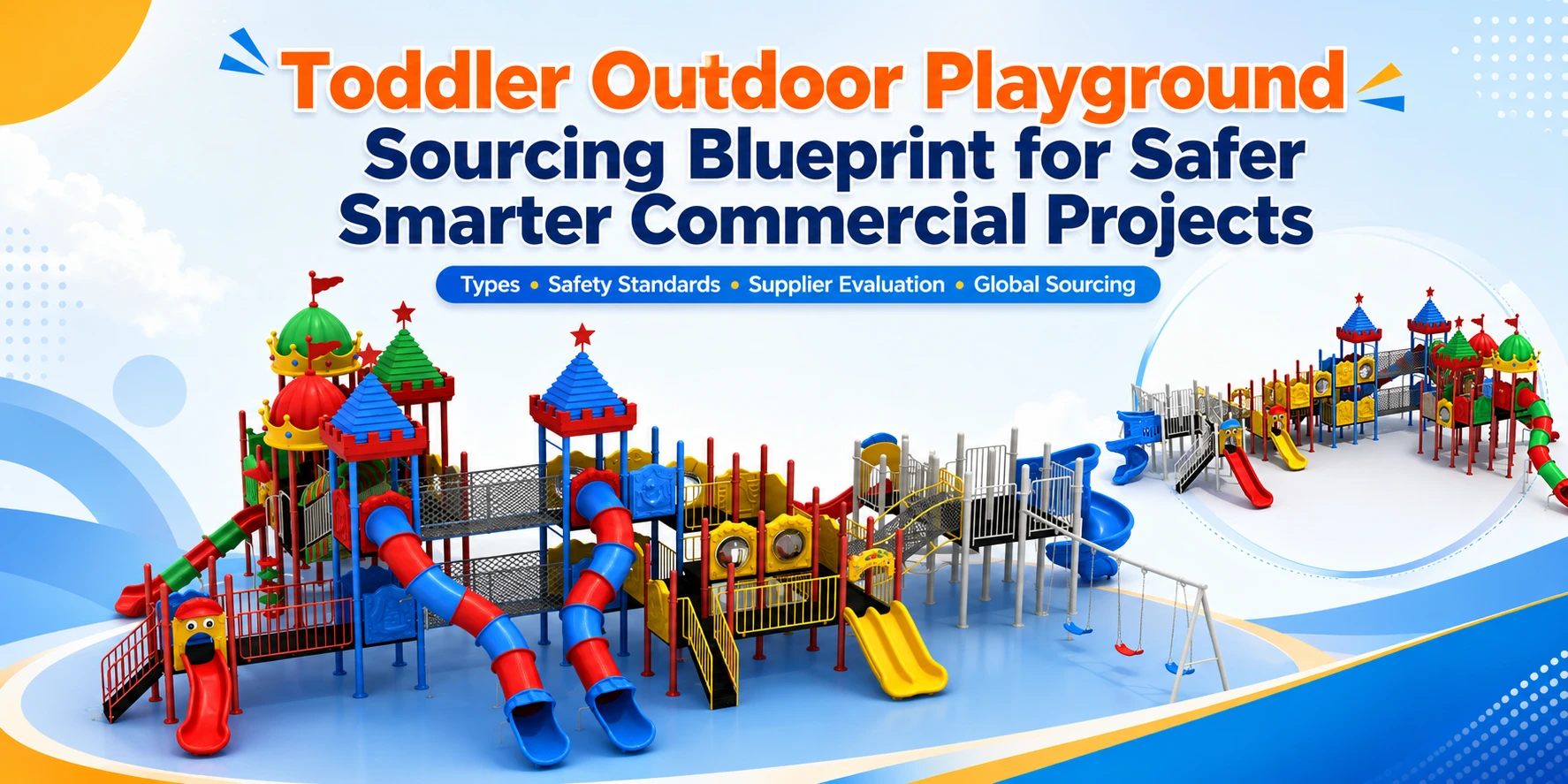
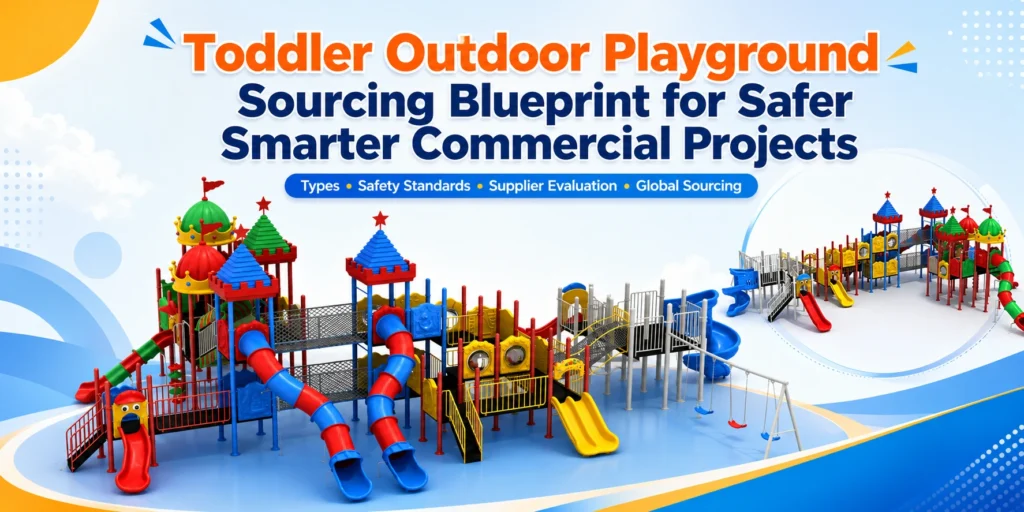
Sourcing toddler outdoor playground equipment for schools, parks, or daycare centres comes with a specific set of challenges. You need structures that are safe for children aged 1–3, durable enough for daily commercial use, and compliant with regional safety standards—all while staying within procurement budgets.
This category covers play equipment with low platforms (under 1.5 m fall height), soft-impact materials, and enclosed designs that minimise fall risks. Slides have shallow inclines, climbing structures use small steps, and sensory panels encourage exploration without sharp edges. Buyers evaluating these products regularly compare durability specs, material options, and supplier certifications before shortlisting.
The following sections walk through equipment types, safety regulations in major markets, supplier evaluation criteria, and global sourcing trade-offs to help you build a reliable procurement plan.
Types of Toddler Outdoor Playground Equipment for Commercial Spaces
Toddler playground equipment for commercial settings must balance developmental value with uncompromising safety. The best options use rotationally moulded PE for impact-resistant panels, powder-coated metal for structural frames, and treated wood—typically Scandinavian pine—for natural-finished play sets. Every component should feature anti-pinch edges and low platform heights under 60 cm to minimise fall risk.
Slides with shallow inclines — widths of 40–50 cm with curved bed ways and gentle 30° slopes. Maximum platform height: 50 cm. These reduce speed while letting toddlers build confidence in controlled descent.
Mini climbing structures — modular arches or step-and-grip panels with handrails spaced 25–30 cm apart. Platforms sit at 30–50 cm high, and enclosed sides prevent sideways falls. Designed for children aged 12–36 months.
Sensory play panels — wall-mounted activity boards featuring spinning gears, bead mazes, and textured surfaces. Mounted at 40–70 cm from ground level. Rotationally moulded PE housing withstands outdoor UV exposure for 5–8 years.
Spring riders — animal-shaped seats with enclosed footrests and central coil springs. Weight capacity of 25–30 kg per unit. The base should fully enclose the spring mechanism to avoid pinch points.
Sand play areas — elevated tables at 45–50 cm height with rounded edges and drain holes. Often combined with built-in moulds or scoops. Treated wood frames resist rot without chemical leaching into sand.
These five categories form the core of any commercial toddler playground you will see among top playground equipment suppliers. When evaluating options, check that all materials meet ASTM F1487 or EN1176 standards for the intended age group. The next section covers those certification requirements in detail.
Critical Safety Standards and Certifications for Toddler Playgrounds
As noted in the previous section, every component you buy should meet ASTM F1487 (U.S.) or EN1176 (Europe). For toddler-specific equipment, these standards enforce three core limits: maximum fall height must stay under 1.5 m, surfacing depth must be sufficient to absorb that impact, and all openings must prevent head entrapment.
The table below compares key requirements across the two main regulatory frameworks.
| Region | Standard | Max Fall Height | Prohibited Openings (to avoid entrapment) |
|---|---|---|---|
| United States | ASTM F1487-21 | 1.5 m | 89 mm–229 mm (or as per CPSC guidelines) |
| Europe | EN 1176-1:2017 | 1.5 m (group‑1) | 89 mm–130 mm for rigid components |
Additional certifications such as TÜV (Germany) or CPSC compliance (U.S.) are common among reliable playground suppliers because they verify that production batches match the tested design.
Beyond certification paperwork, look for design details that prevent injury: cushioned edges around platforms, rounded corners on all metal junctions, and soft-impact zones in high-traffic areas. These features are standard among best playground equipment manufacturers China that export to regulated markets.
How to Evaluate a Toddler Playground Supplier for Your Project
Vetting a playground supplier for a commercial project demands more than browsing catalogues. Use this five-step process to build your playground supplier shortlist and compare candidates objectively.
-
Verify certifications and test reports. Request copies of ASTM F1487 or EN1176 compliance certificates. Ask for third-party test reports from labs like TÜV or SGS — not just supplier self-declarations.
-
Request material samples and inspect for quality. Ask for cut samples of rotomoulded PE panels (check thickness — minimum 8 mm is typical). Examine metal coating for uniform coverage and wood for splinter-free treatment. Test any edge or hinge for smooth operation.
-
Assess customisation capability. Can the supplier match your brand colours, add logos, or adjust layout dimensions? Ask about minimum colour call-out quantities and lead times for custom orders. This is critical for an outdoor playground supplier comparison where flexibility varies.
-
Clarify MOQ, lead times, and payment terms. Commercial sets often have minimum order quantities of 5–10 units. Typical production lead time is 30–60 days. Confirm payment terms (e.g. 30% deposit, 70% before shipment) and whether LC terms are accepted.
-
Inquire about after-sales support. What warranty covers the equipment — typical range is 2–5 years? Are spare parts (sliding boards, replacement panels) stocked locally? Can they provide installation manuals or on-site supervision?
Include these items in your RFQ documents checklist:
- Project site dimensions and intended surfacing type (rubber tiles, poured-in-place, sand)
- Target age group and required fall height
- Preferred materials, colours, and any branding specifications
- Required certifications list (ASTM, EN1176, CPSC)
- Requested quantity, delivery destination, and deadline
- Customisation details (layout changes, branding)
- Expected warranty period and spare parts availability
Global Sourcing Strategies: China vs. Other Markets
| Sourcing Region | Unit Cost & MOQ | Lead Time | Certification Acceptance | Customisation Flexibility |
|---|---|---|---|---|
| China | 30–50% lower; MOQ often 50+ units | 45–90 days | ASTM/EN1176 accepted but may need supplier-led re-testing | High; custom colours, branding, layout changes standard |
| Europe | 20–40% above China; MOQ 10–20 units | 30–60 days | EN1176 pre-certified; easier for EU projects | Moderate; limited colour options, fixed catalogues |
| North America | Similar to Europe; MOQ 10–25 units | 60–90 days | ASTM F1487 pre-certified; CPSC compliant | Moderate; branding possible, structural changes slow |
China’s lower unit cost comes with trade-offs. You will face higher MOQs and longer freight times, and certification documents may require factory re-testing before your buyer accepts them. Western suppliers charge 20–40% more but deliver pre-certified equipment with faster lead times for domestic or nearby projects. Customisation is where China pulls ahead — most Chinese factories treat colour changes, logo moulding, and layout alterations as standard requests, not premium extras.
To verify Chinese manufacturers, invest in an independent third-party factory audit (Bureau Veritas or SGS). Request samples before production and schedule a pre-shipment inspection to check material grade, weld quality, and fall-height compliance. For an indoor playground supplier comparison, treat certification readiness and audit history as your primary filters.
Once your sourcing geography is selected, the next step is clarifying installation, warranty, and expansion options — common buyer questions that affect total lifecycle cost.
Frequently Asked Questions About Toddler Outdoor Playground Equipment
What age range is toddler playground equipment designed for?
Toddler equipment is built for children aged 12 months to 3 years. Platforms sit under 0.6 m high, and slides have gentle slopes of 30 degrees or less. Falls from this height rarely exceed 1.5 m, keeping within ASTM F1487 and EN1176 limits.
What surfacing materials are recommended?
Use rubber wet-pour, rubber tiles, or engineered wood fibre under and around equipment. Wet-pour needs 30–40 mm depth; loose fill requires 300 mm for critical fall zones. Avoid concrete, asphalt, or grass — they offer no impact absorption.
How long does a typical playground take to install?
A small toddler zone (2–3 activities) generally takes 2–4 days on site, assuming ground preparation is complete. Larger commercial installations with bespoke layouts run 5–10 days. Modular designs reduce labour time by 30% compared with welded structures.
What warranty should I expect?
Expect 10–15 years on structural components (steel frames, rotationally moulded polyethylene) and 1–2 years on moving parts like spring mechanisms or bearings. A longer warranty often correlates with higher material quality, worth checking in playground equipment supplier reviews.
Can equipment be expanded later?
Yes, if you choose a modular system from the start. Many manufacturers design bolt-on sections that add slides, climbing panels, or sensory walls later. This avoids replacing the entire layout and reduces long‑term cost. For high‑flexibility sourcing, some buyers evaluate the best playground factory China offers for modular expansions.
About JQ Playground – bestplaygroundsuppliers.com
JQ Playground (Wenzhou Jiqi Amusement Equipment Co., Ltd.) is a children’s playground equipment manufacturer founded in 1993. The company provides design, customization, large-scale manufacturing, sales, installation guidance, and after-sales support for outdoor playgrounds, indoor playgrounds, soft play, water playgrounds, PE board playgrounds, kindergarten furniture, outdoor fitness equipment, pet playgrounds, and playground facilities. Approved company facts include 180+ employees, a large Wenzhou production base, 20+ production lines, 55 production machines, ISO/BSCI/EN1176/EN71/ASTM/CPC/CPSIC certification references, 100+ patents, free design support, OEM/ODM capability, trial installation before shipping, export experience, and one-year quality warranty.