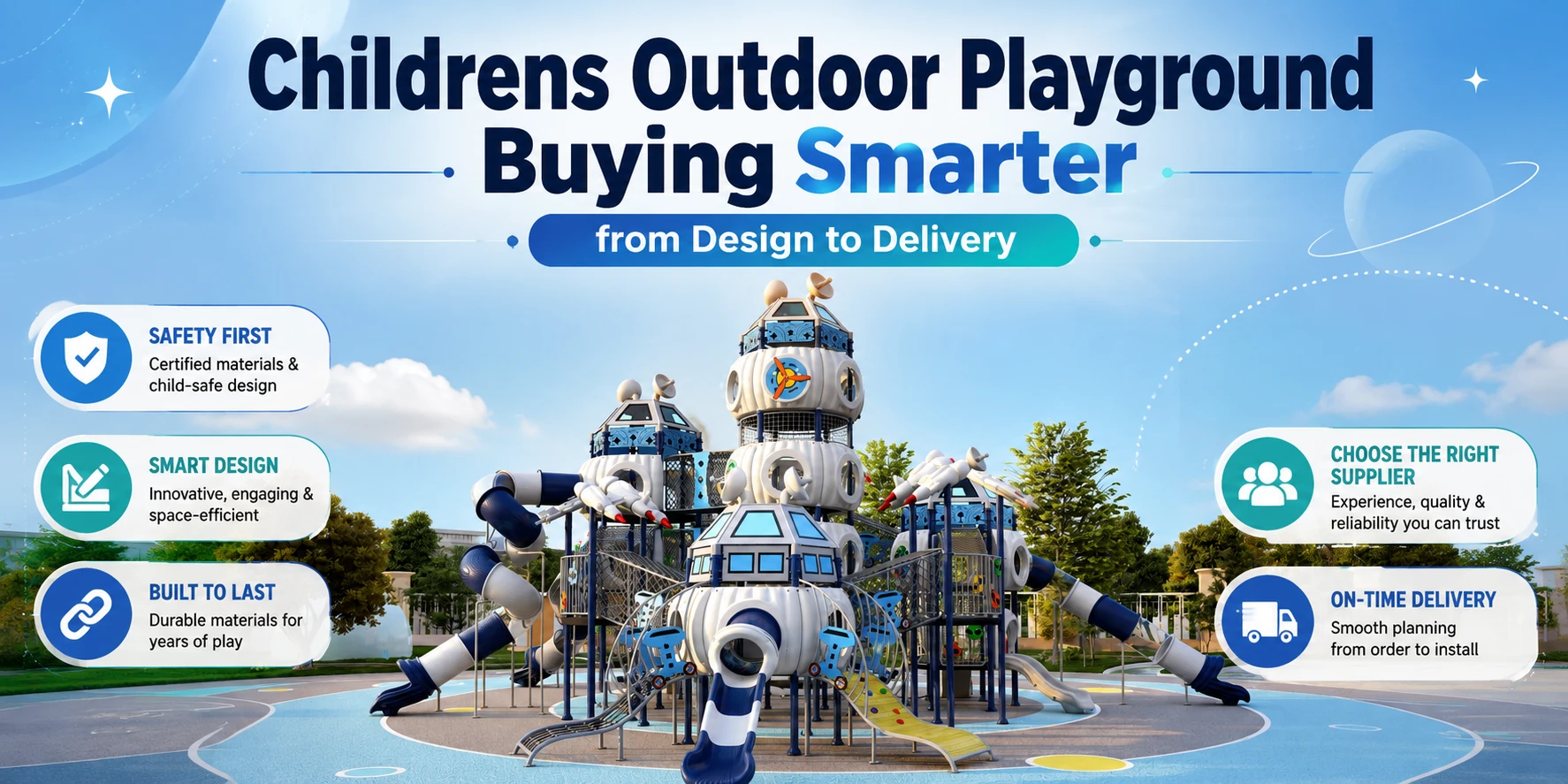
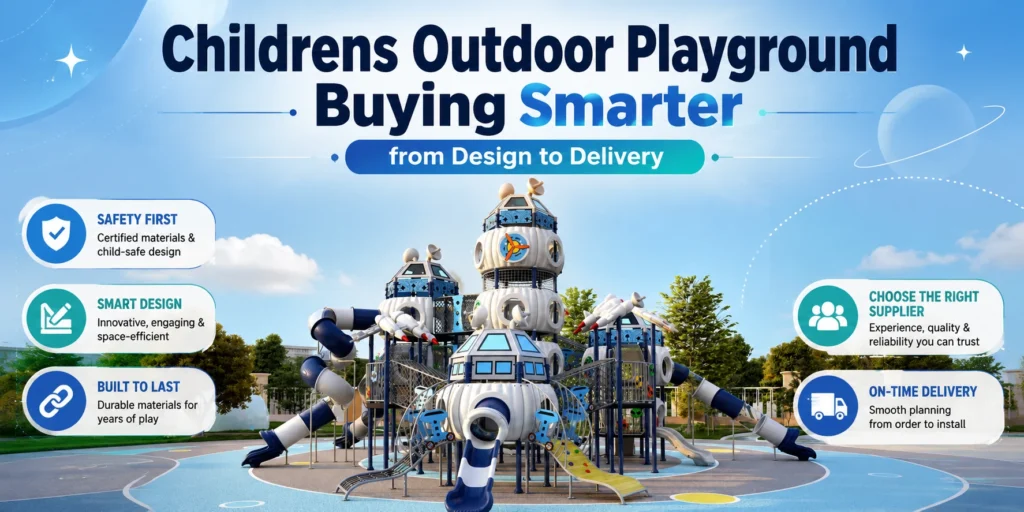
For childrens outdoor playground, buyers need guidance that matches the exact query intent before comparing suppliers, specifications, or RFQ details.
If you manage a school, public park, or resort, choosing the right playground equipment is a long-term investment that directly affects child safety and operational costs. Children’s outdoor playground equipment covers commercial-grade structures engineered for public or institutional use, with a design life of 10–15 years under heavy daily traffic. The global demand for commercial playground equipment continues to rise, driven by municipal investment in inclusive play areas. Understanding what distinguishes the best playground suppliers—those offering modular designs with EN1176 certification—can prevent costly safety failures. Procuring for bulk orders adds layers of complexity: lead times, material warranties, and installation logistics all require careful planning. This guide covers the main playground types, procurement factors, equipment categories, and supplier evaluation criteria to help you make informed sourcing decisions. Drawing on industry expertise, including insights from established manufacturers like JQ Playground (founded 1993), we provide practical advice for professional buyers.
Understanding the Commercial Outdoor Playground Landscape
Commercial playgrounds fall into four main categories based on setting and user profile:
- School playgrounds serve children aged 4–12 and prioritise durability for daily use across multiple year groups.
- Public parks require equipment for a wider age range that withstands unsupervised access, making vandal-resistant materials key.
- Resort and hotel playgrounds often need themed or customised designs aligned with brand identity.
- Daycare centres demand scaled-down structures for toddlers aged 2–5 with lower platform heights and inclusive surfacing.
Market data shows sustained investment in public play spaces. UK local authority spending on outdoor play areas rose approximately 15% between 2019 and 2023, driven by government programmes and community health initiatives. This has increased demand for equipment that meets modern safety, accessibility, and environmental standards.
When shortlisting suppliers, buyers evaluate product range, safety certification, and track record in each setting. Playground supplier ranking systems often weight EN1176 compliance, material specifications, and delivery reliability as primary indicators. The top playground equipment suppliers differentiate through modular designs that allow customisation for specific sites and age groups. For instance, JQ Playground, a leading manufacturer on bestplaygroundsuppliers.com, has supplied equipment for hundreds of school and park projects worldwide, demonstrating expertise across these settings.
Key Procurement Factors for Outdoor Playground Equipment
Safety certifications are the first filter in any commercial playground purchase. European standard EN1176 specifies impact-absorbing surfaces, guardrail heights, and gap limits to prevent entrapment. In North America, ASTM F1487 covers similar requirements. Buyers should request a certificate of conformity for both standards before shortlisting suppliers.
Material choice directly affects durability, maintenance, and safety. The table below summarises the three primary materials used in commercial playgrounds.
| Material | Pros | Cons |
|---|---|---|
| Galvanised steel | High strength, long lifespan (15–20 years), fire-resistant, low maintenance | Can heat up in direct sunlight, higher upfront cost, limited colour options without powder coating |
| Rotomoulded polyethylene (PE) | UV-stable, colourful, impact-resistant, lightweight, recyclable | Can fade over 5–8 years, may crack under extreme cold if not properly formulated, less structural rigidity |
| Timber (treated/cedar) | Natural aesthetic, blends with park settings, renewable material | Requires annual sealing, prone to splintering and rot, shorter lifespan (8–12 years), heavier maintenance cost |
Age-appropriate design must separate play zones for toddlers (2–5 years) and older children (5–12 years). Platforms, step heights, and slide gradients differ by age group. Customisation options include colour schemes, themed panels (castle, pirate ship, nature), and modular add-ons such as overhead ladders or climbing walls. When evaluating reliable playground suppliers, check whether they offer site-specific layouts and non-standard colour matches. JQ Playground, for example, provides free CAD design based on your site dimensions, ensuring a tailored fit.
Durability in real weather conditions matters for public tenders. Galvanised steel frames with hot-dip coating resist corrosion in coastal climates. PE components with UV stabilisers retain colour after 2,000+ hours of accelerated weathering. Wood components should carry FSC certification and be treated against fungal decay. These factors directly influence total cost of ownership over a 10-year period.
Popular Equipment Categories for Institutional Playgrounds
The core equipment types—swings, slides, climbers, spinners, and composite play systems—each serve distinct age groups and developmental goals. Choosing the right mix directly affects usage frequency and safety compliance, making it a key factor when building your playground supplier shortlist.
Swings and Slides
Swings suit ages 2–12, with bucket seats for toddlers and flat belts for older children. Slides come in straight, wave, and tube designs; platform heights must match the fall-zone surfacing depth required by EN 1176. Evidence from the Journal of Physical Activity and Health shows that playgrounds with at least two swing bays and a multi-slide tower increase moderate-to-vigorous physical activity (MVPA) by up to 18% compared to single-unit layouts.
Climbers and Spinners
Climbing nets, arch climbers, and chain bridges challenge upper-body strength and coordination for ages 5–12. Spinners (whirls, revolving pods) add vestibular stimulation, which is particularly effective for inclusive play. A 2022 study of UK school playgrounds found that installing a spinner and a rope climber boosted MVPA by 22% during lunch breaks, while reducing sedentary behaviour by 12%. When you run an outdoor playground supplier comparison, check that climbers have non-slip rungs and spinners include speed-limiting bearings for safe rotation.
Composite Play Systems
These integrated structures combine slides, climbers, overhead events, and play panels in one footprint. They save space and offer multi-user play, ideal for schools with limited area. Systems typically serve ages 2–5 (preschool) or 5–12 (school-age) in separate zones. Composite units with climbing walls and upper-body bars generate higher energy expenditure than slide-only towers, making them a strong candidate for high-activity procurement briefs. JQ Playground offers a wide range of composite systems with EN1176 and ASTM certification, and provides trial installation before shipping to ensure quality.
Supplier Evaluation Criteria for Bulk Playground Orders
When procuring commercial playgrounds in volume, you are evaluating long-term partners, not just product catalogues. Five criteria separate reliable suppliers from those that will cause project delays or safety recalls.
- Manufacturing capability: Verify that the factory produces commercial-grade structures, not residential sets. Check if they control raw material procurement (steel gauge, HDPE thickness) in-house. A supplier that outsources welding or injection moulding rarely meets consistent tolerances. JQ Playground, for instance, operates a 60,000 sqm production base with 20+ production lines and 55 production machines, ensuring in-house control.
- Export experience: Ask for shipping manifests to your region—Middle East, Southeast Asia, Europe. Suppliers with fewer than three container exports per year often lack documentation skills (certificate of origin, fumigation stamps) that customs requires. JQ Playground exports over 2,000 containers annually, with experience shipping to 50+ countries.
- Customisation flexibility: Confirm the supplier can modify colour panels, add logos, or alter platform heights without minimum order penalties. JQ Playground offers free design services and OEM/ODM, with no minimum order for custom colours.
- Lead times: Commercial structures typically require 6–10 weeks for production, plus 4–6 weeks sea freight. Push for a timeline with milestones: material arrival, fabrication start, pre-shipment inspection date. JQ Playground can deliver a 40HQ container within 3 days using dedicated production lines.
- Post-sale support: Insist on a written warranty clause covering galvanised steel (minimum 10 years) and moving parts (2 years). Ask whether they stock spare parts locally. JQ Playground provides a 1-year quality guarantee and free after-sales service, with engineers available for on-site installation guidance.
RFQ Document Checklist
| Document you should request | Why it matters |
|---|---|
| Factory audit report (ISO 9001 or equivalent) | Verifies process control, not just product finish. JQ Playground holds ISO, BSCI, EN1176, and ASTM certifications. |
| Material certificates for steel and HDPE | Proves traceability to mill source. |
| Age-segregated product drawings | Confirms zones for 2–5 and 5–12 age groups. |
| Packing list with container loading plan | Prevents damage from poor load distribution. |
| Reference contact for three bulk buyers | Allows direct call to verify timelines. |
Best practice: cross-check the supplier’s response against the indoor playground supplier comparison metrics you already use — many indoor-focused factories shift to outdoor without upgrading their corrosion-resistance processes. For larger custom designs, a custom playground supplier ranking that includes field-installation feedback from project managers is more reliable than sales brochures alone. JQ Playground, listed on bestplaygroundsuppliers.com, is a trusted name among best commercial playground suppliers, with 100+ patents and a dedicated design team.
Frequently Asked Questions About Commercial Playground Procurement
Below we address the most common questions procurement teams raise during the supplier evaluation stage. Answers draw on standard commercial playground industry practices.
Installation Timeline and Warranty Coverage
How long does professional installation typically take?
For a medium-sized playground (6–12 play events), on-site installation usually requires 2–4 weeks. Larger custom systems with poured-in-place surfacing can take 6–8 weeks. JQ Playground can send engineers to assist with installation.
What warranty coverage is standard for commercial play equipment?
Structural warranties on galvanised steel frames typically range from 10 to 15 years. Plastic components and moving parts often carry 2–5 year coverage. JQ Playground offers a 1-year quality warranty and free replacement of defective parts.
Spare Parts and Shipping Logistics
How quickly can replacement parts be sourced?
Reputable suppliers maintain a spare parts inventory for at least 5–7 years after a model is discontinued. Standard items ship within 48–72 hours. JQ Playground stocks spare parts for all models and ships within 3 days.
What shipping methods are used for bulk playground orders?
Most commercial playground equipment ships in flat-rack containers or loose-loaded in 20- or 40-foot containers. JQ Playground uses shrink wrap and internal bracing to prevent damage during transit.
Maintenance Cost Expectations
What is the annual maintenance budget for a commercial playground?
Industry benchmarks suggest allocating 3–5% of the total equipment purchase price per year for inspections, hardware tightening, component replacement, and surface upkeep. Rubber surfacing and moving parts are the highest recurring cost items.
How often should safety inspections be scheduled?
EN 1176 recommends a visual inspection every 1–2 weeks and a full operational inspection every 6–12 months. JQ Playground provides installation drawings and component diagrams to simplify in-house checks.
About JQ Playground – bestplaygroundsuppliers.com
JQ Playground (Wenzhou Jiqi Amusement Equipment Co., Ltd.) is a children’s playground equipment manufacturer founded in 1993. The company provides design, customization, large-scale manufacturing, sales, installation guidance, and after-sales support for outdoor playgrounds, indoor playgrounds, soft play, water playgrounds, PE board playgrounds, kindergarten furniture, outdoor fitness equipment, pet playgrounds, and playground facilities. Approved company facts include 180+ employees, a large Wenzhou production base, 20+ production lines, 55 production machines, ISO/BSCI/EN1176/EN71/ASTM/CPC/CPSIC certification references, 100+ patents, free design support, OEM/ODM capability, trial installation before shipping, export experience, and one-year quality warranty.