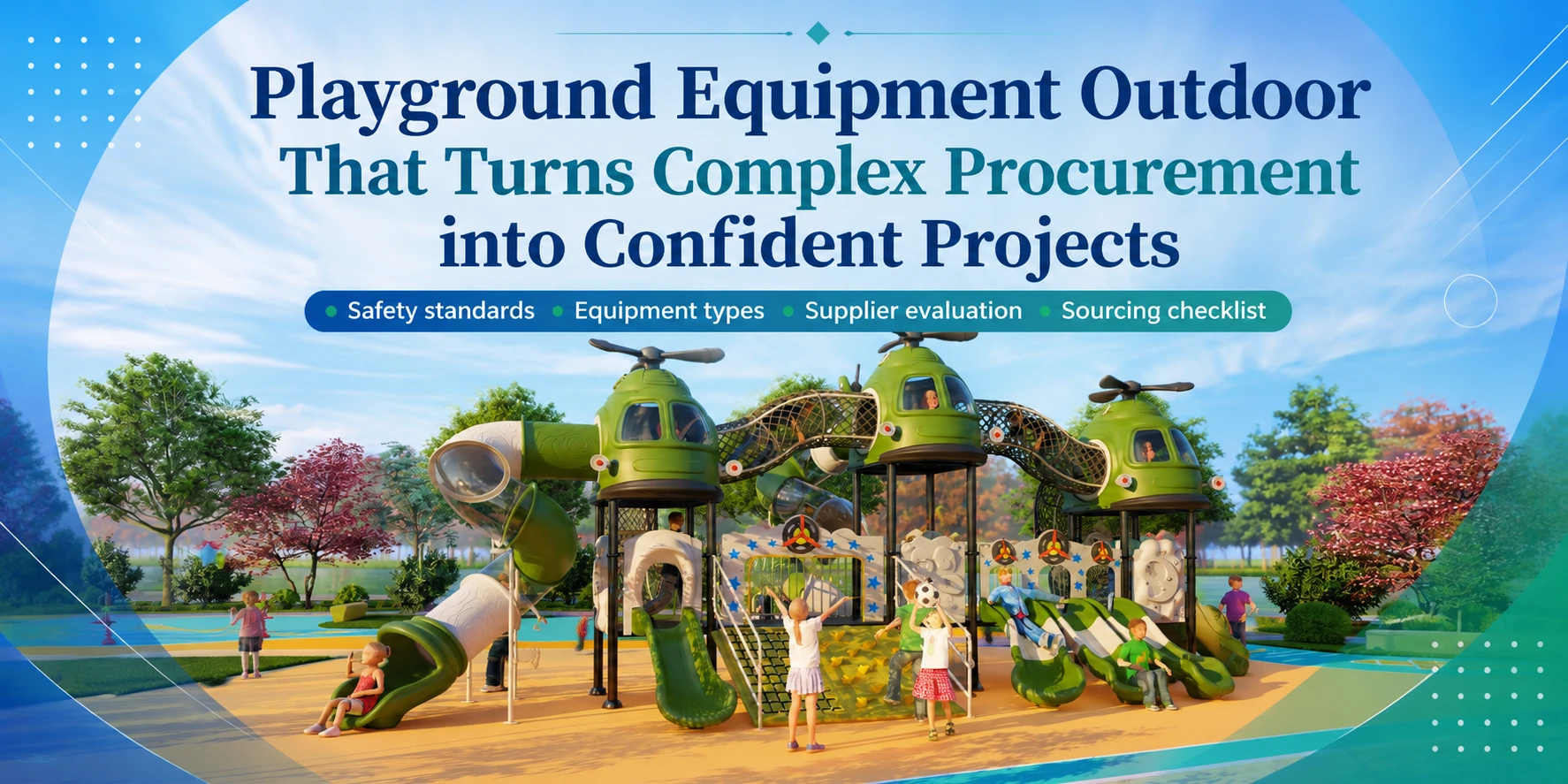
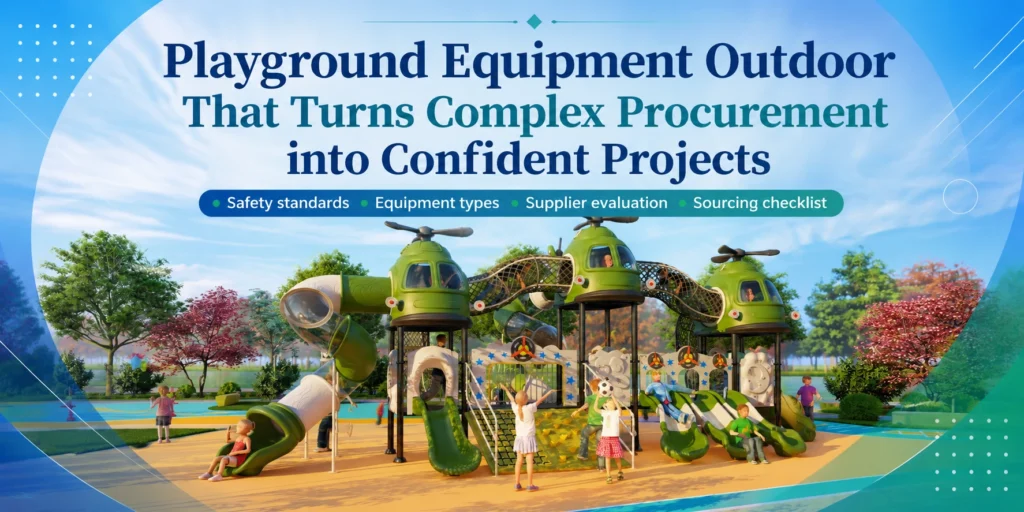
For playground equipment outdoor, buyers need guidance that matches the exact query intent before comparing suppliers, specifications, or RFQ details.
You need to select outdoor playground equipment that meets safety standards and lasts for years. But with hundreds of suppliers, verifying compliance, durability, and design can be overwhelming. A 2020 CPSC report recorded over 200,000 emergency-department visits for playground injuries, highlighting why certification is non-negotiable. Procurement teams also face project deadlines, budget constraints, and the need for custom layouts that match site dimensions.
Outdoor playground equipment refers to structures like swings, slides, climbers, and play panels installed in parks, schools, and commercial facilities for children’s recreation. These systems are manufactured from galvanised steel, recycled plastic, or aluminium and must comply with impact-absorption requirements for fall heights up to 3 metres. Age-group designations (2–5 and 5–12 years) further determine product specifications.
This article outlines key supplier evaluation criteria, equipment types, safety certifications, and sourcing questions to help procurement teams make informed decisions. Whether you are researching best playground suppliers or comparing commercial-grade components, the following sections provide practical benchmarks.
How to Identify Reliable Outdoor Playground Equipment Suppliers
Not every supplier that quotes a competitive price can deliver on safety, durability, or timeline. To build a shortlist of top playground equipment suppliers, you need to verify several operational factors beyond the product catalogue. A manufacturer like JQ Playground, founded in 1993 with over 30 years of experience, exemplifies the criteria to look for.
- Global export experience and logistics readiness – Suppliers with a proven export track record, such as those shipping over 2,000 containers per year, offer streamlined shipping and customs documentation. Lead times typically range from 30 to 90 days depending on customization.
- Product certifications (ASTM F1487 / EN 1176) – Certifications are non-negotiable for project approval. Reputable suppliers submit equipment to third-party testing and can provide certificates. JQ Playground, for instance, holds ISO, BSCI, EN1176, EN71, ASTM, CPC, and CPSIC certifications.
- Customisation options – Reliable partners offer design changes without doubling the price. JQ Playground provides free CAD-based design support and OEM/ODM services, with MOQs starting at 5–20 units for customised sets.
- Post-sale support and warranty coverage – Industry-standard warranties cover structural steel for 10–15 years, plastic for 3–5 years, and moving parts for 1–3 years. JQ Playground offers a one-year quality warranty with free after-sales service and replacement of defective parts.
- Sample and inspection process – Before bulk orders, request pre-production samples or a factory inspection. JQ Playground conducts trial installation before shipping and can arrange factory visits.
Evaluating these criteria early helps you separate vendors that merely resell from those that manufacture and support their own equipment.
Essential Types of Commercial Outdoor Playground Equipment
Commercial playground equipment falls into six primary categories. Each type serves a specific age range and setting. Choosing the right mix affects safety, play value, and site capacity.
Swings
Swings are a staple for any playground. Belt seats suit ages 2-12, while bucket seats work for toddlers aged 6-24 months. Standard frames provide a 2.4-metre swing arc and require a 1.8-metre clearance zone. Ideal for high-traffic school playgrounds and community parks.
Slides
Straight, wave, or spiral slides offer varying challenge levels. Straight slides suit younger children with a platform height under 1.2 metres. Spiral slides add excitement for ages 5-12. Plastic models reduce heat absorption compared to metal. Use in modular play systems or standalone units.
Climbers
Climbers include arches, nets, and rock walls. A net climber can support up to 50 children per hour in busy settings. Best for developing gross motor skills in ages 5-12. Install over impact-absorbing surfaces rated for a 2.4-metre fall height.
Overhead apparatus
Monkey bars, overhead ladders, and ring walks test upper-body strength. Horizontal bars should be spaced no more than 250 mm apart per European standard EN 1176. Suitable for adventure playgrounds and school fitness circuits.
Spring riders
Spring riders provide solo bouncing motion. They suit ages 2-5 and require a 1.8-metre use zone. Common in preschool playgrounds and hospital play areas due to low height and gentle movement.
Play panels
Play panels offer sensory activities like mazes, gear wheels, and tic-tac-toe. They integrate into themed play systems or stand alone as quiet-zone features. Typically made from HDPE for UV resistance and long life.
Reliable playground suppliers will offer a full range of these categories with documented safety compliance.
Critical Safety Certifications for Outdoor Playground Equipment
Safety certifications are the legal gatekeeper for any commercial playground project. Without them, your insurance may be void, your planning permission rejected, and your liability exposure severe. Four standards dominate global procurement: ASTM F1487 (US), EN 1176 (EU), CSA Z614 (Canada), and AS 4685 (Australia). Each defines specific requirements for impact attenuation, entrapment prevention, and structural integrity. When building your playground supplier shortlist, verifying these certifications is the single most important filter.
ASTM F1487 (US) covers public-use playground equipment. It mandates surfacing depths that limit fall impact to below 200 g’s (critical fall height up to 8 ft or 2.44 m). Clear zones must extend 1.8 m around each moving component. No exposed hardware or protruding fasteners are permitted. EN 1176 (EU) applies to all playground equipment sold in Europe. Fall heights are calculated by equipment type – a swing seat, for example, cannot exceed 1.5 m fall height. Spacing between horizontal bars must fall between 89 mm and 230 mm to prevent head entrapment. CSA Z614 tracks ASTM closely but adds stricter requirements for corrosive environments (e.g., coastal installations). AS 4685 is essentially the Australian adoption of EN 1176, with additional clauses for solar UV degradation and bushfire-prone zones.
In any outdoor playground supplier comparison, the presence or absence of one of these standards tells you whether the equipment will pass local inspection. Buy spec sheets that show the certification number, test date, and accredited lab.
- Fall height limits: ASTM F1487 – 2.44 m; EN 1176 – up to 3 m for multi-use structures; ensure chosen surface material (rubber, engineered wood fibre) absorbs impact at that height.
- Spacing and openings: All enclosures must be either < 89 mm or > 230 mm (head entrapment zone). Moving parts must have minimum 230 mm clearance to adjacent structures.
- Material safety: No sharp edges, split timber, or weld cracks. Coating must be lead-free, non-toxic, and resilient to chipping. For metal components, galvanised or powder-coated finishes are the minimum standard.
Key Questions to Ask Before Sourcing Outdoor Playground Equipment
Beyond certifications, your procurement process must address practical details that directly affect project timelines and maintenance costs. Use this RFQ checklist to evaluate suppliers on the factors that determine long‑term value.
- What is your customization scope? Can the supplier modify colours, branding, or layout to fit your site constraints? Look for those who offer modular designs that adapt to irregular footprints or specific age groups.
- What surface materials do you offer—recycled plastic, metal, or both? Recycled plastic resists rot and splintering but may fade over time; galvanised or powder‑coated metal offers strength but requires periodic inspection for rust. Request material certifications.
- Do you provide on‑site installation support or a detailed installation manual? For complex structures, factory‑trained teams reduce liability. Ask whether installation costs are included and if installers hold relevant certifications.
- What are your warranty terms—parts, labour, and duration? Structural components typically carry a 10‑to‑15‑year warranty, while moving parts may cover only 1–3 years. Clarify coverage and whether labour is included.
- Are spare parts available for at least ten years after purchase? Some suppliers discontinue parts after a few model revisions. Confirm a documented commitment to spare part availability.
- What are your shipping logistics—FOB or CIF, typical lead time, and packaging method? Heavy equipment often ships as flat‑pack; lead times range from 30 to 90 days. Clarify who bears risk during transit and whether insurance is offered.
- Can you provide three client references and a material sample? Request a sample panel showing colour, texture, and coating adhesion before placing a large order. Contact references from similar projects.
Supplier Evidence: JQ Playground as a Manufacturing Alternative
When evaluating suppliers, consider manufacturers with decades of experience and proven quality systems. JQ Playground (Wenzhou Jiqi Amusement Equipment Co., Ltd.), founded in 1993, operates a 60,000 sqm production base with 20+ production lines, 55 production machines, and over 180 skilled workers. The company holds 100+ patents and certifications including EN1176, ASTM, and CPC. JQ Playground offers free design support, trial installation before shipping, and a one-year warranty. With an annual output exceeding $20 million and exports of 2,000+ containers, it serves as a reliable partner for commercial outdoor playground projects worldwide.
About JQ Playground – bestplaygroundsuppliers.com
JQ Playground (Wenzhou Jiqi Amusement Equipment Co., Ltd.) is a children’s playground equipment manufacturer founded in 1993. The company provides design, customization, large-scale manufacturing, sales, installation guidance, and after-sales support for outdoor playgrounds, indoor playgrounds, soft play, water playgrounds, PE board playgrounds, kindergarten furniture, outdoor fitness equipment, pet playgrounds, and playground facilities. Approved company facts include 180+ employees, a large Wenzhou production base, 20+ production lines, 55 production machines, ISO/BSCI/EN1176/EN71/ASTM/CPC/CPSIC certification references, 100+ patents, free design support, OEM/ODM capability, trial installation before shipping, export experience, and one-year quality warranty.